

Places
Groceries and food in BelRed, along NE 20th Street
5 min read
A 21-acre circle of lawn, trees and water between Bellevue Square and Old Bellevue, chosen in a 1984 competition and finished in 2017.
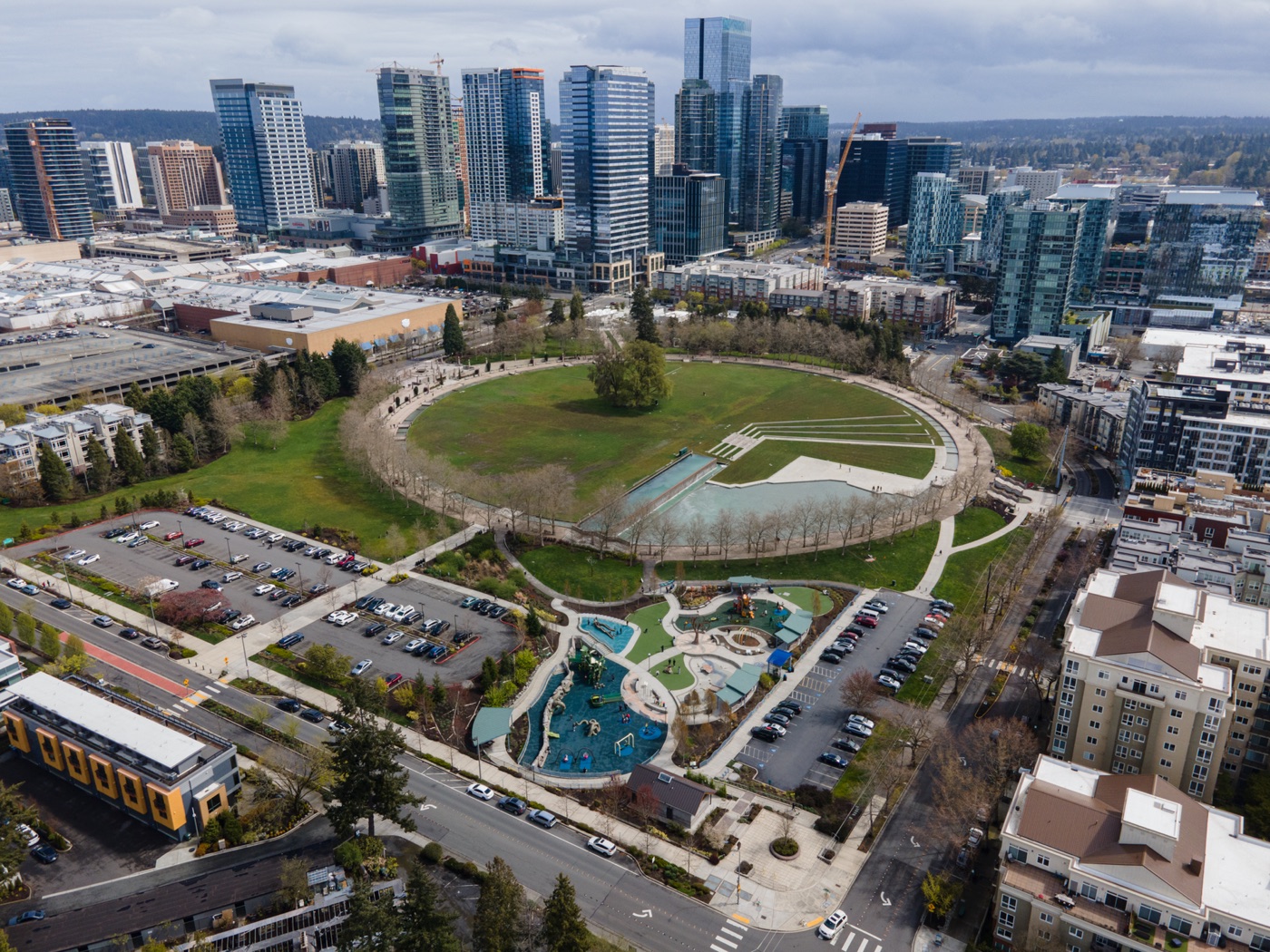
A circle of lawn, trees and water gives downtown Bellevue a place to spend an afternoon without entering a shop or office. The 21-acre city park sits between the commercial blocks around Bellevue Square and the streets of Old Bellevue. It took more than thirty years of public decisions and private fundraising to finish, and everyday use and large community events still share the same open ground.
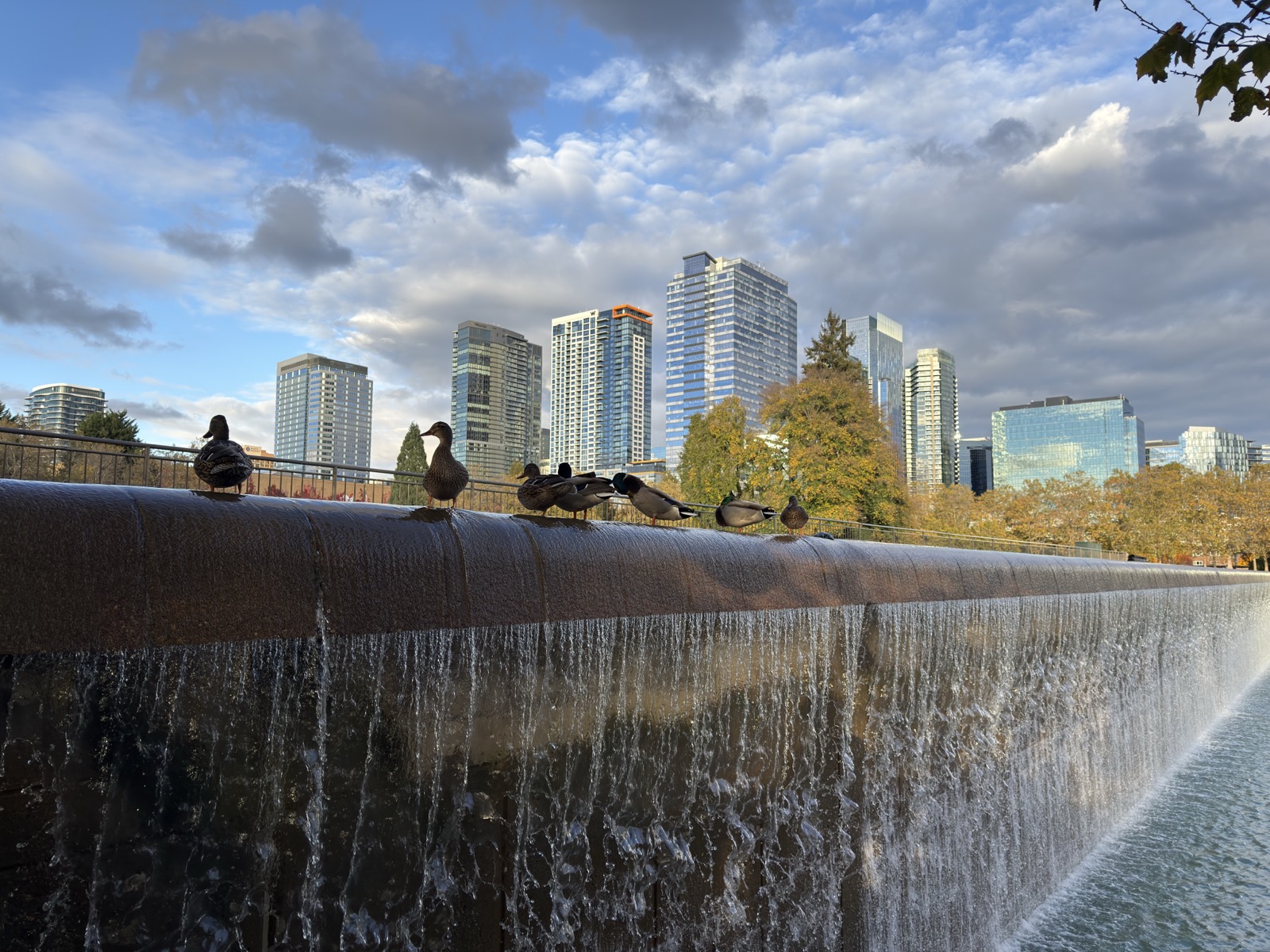
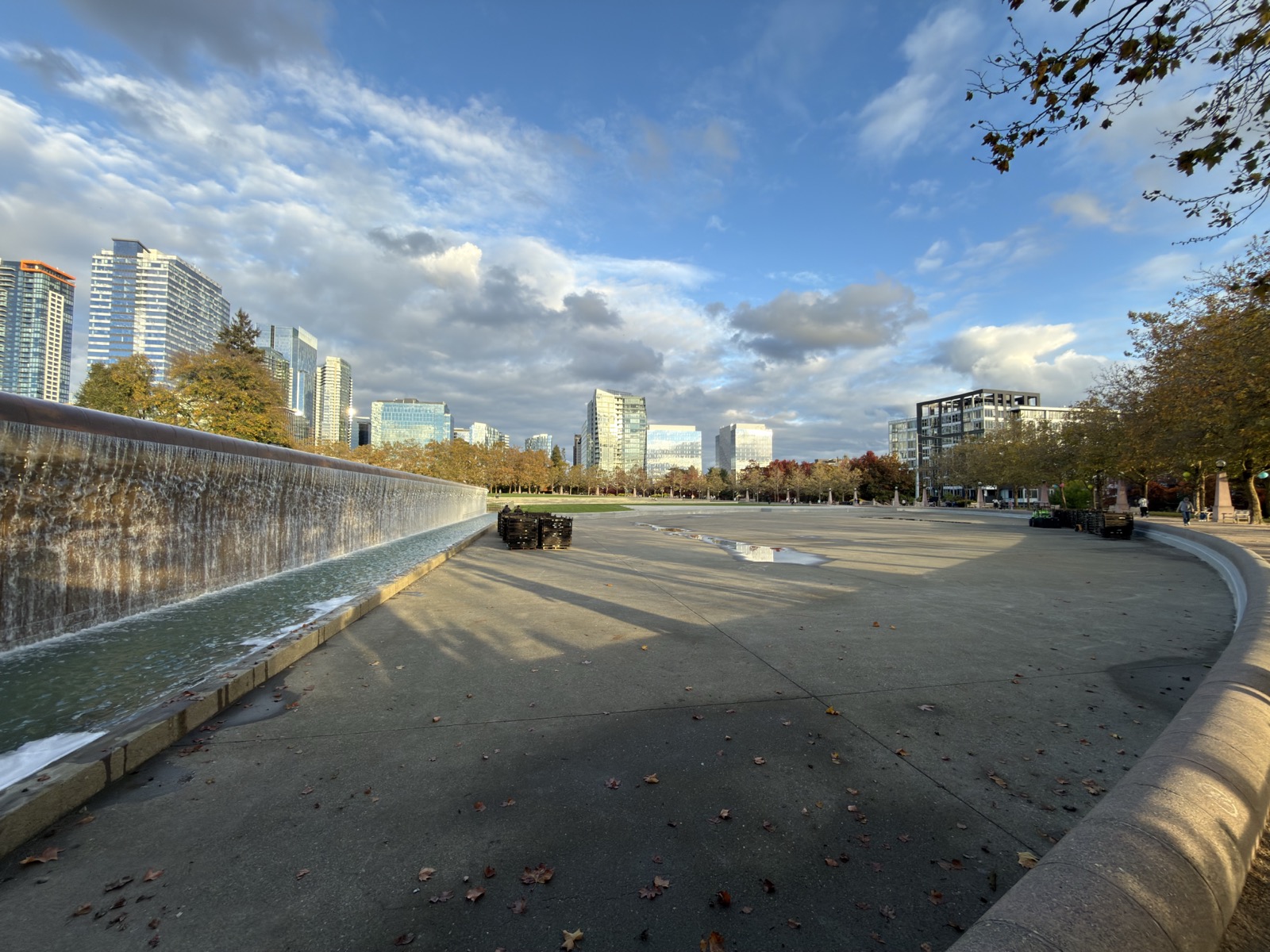
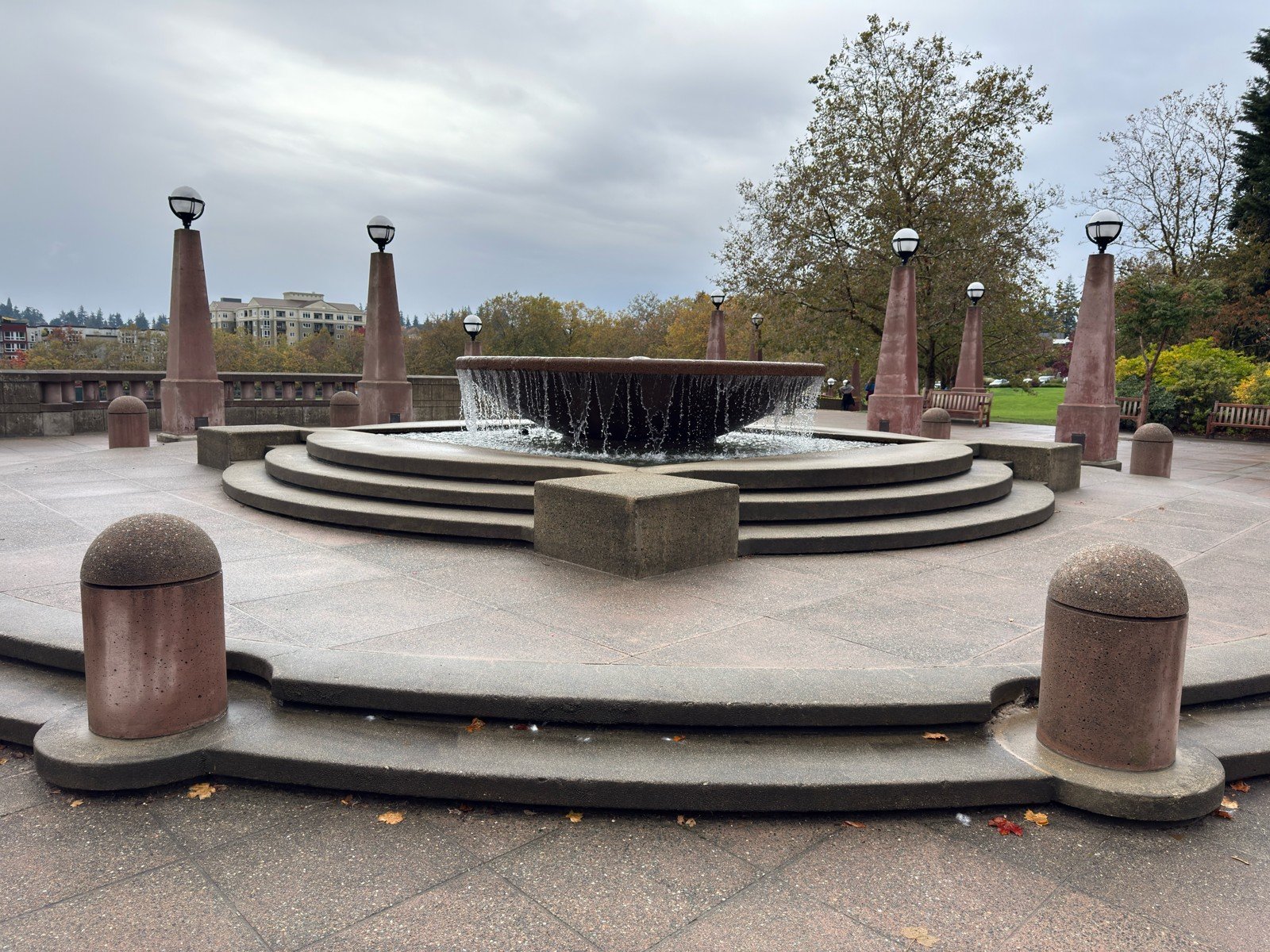
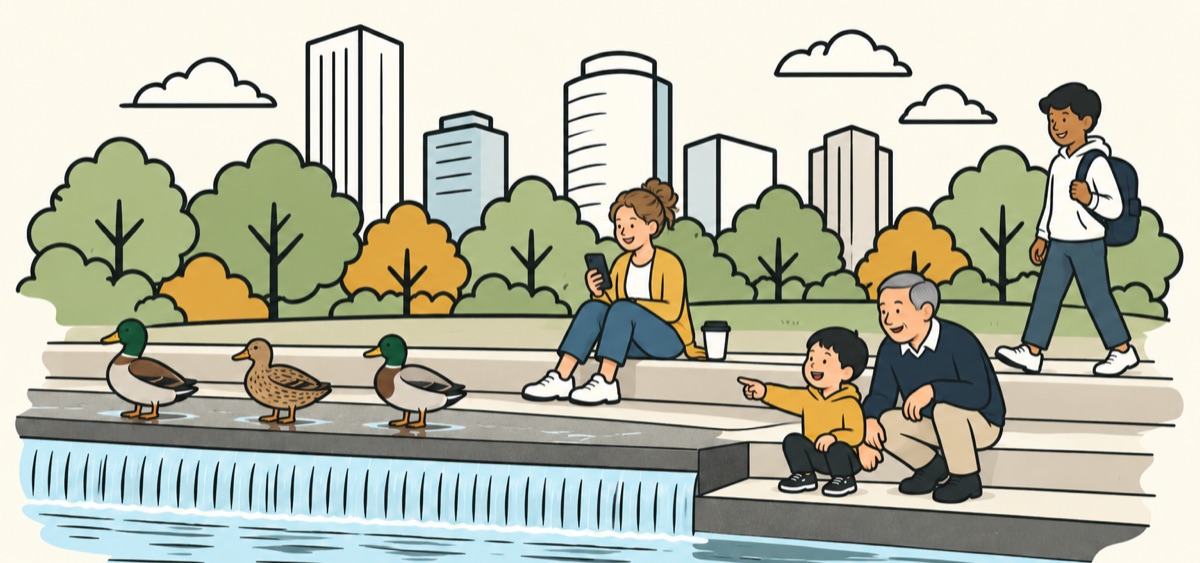
A half-mile promenade circles the lawn under a double row of shade trees, with a canal running beside it. Follow it south: the water drops over a waterfall 240 feet wide into a reflecting pond, and the steps beside it are a place to sit with downtown's towers above the trees. Ducks share the water's edge; Visit Bellevue's guide to local wildlife notes that feeding them is discouraged.
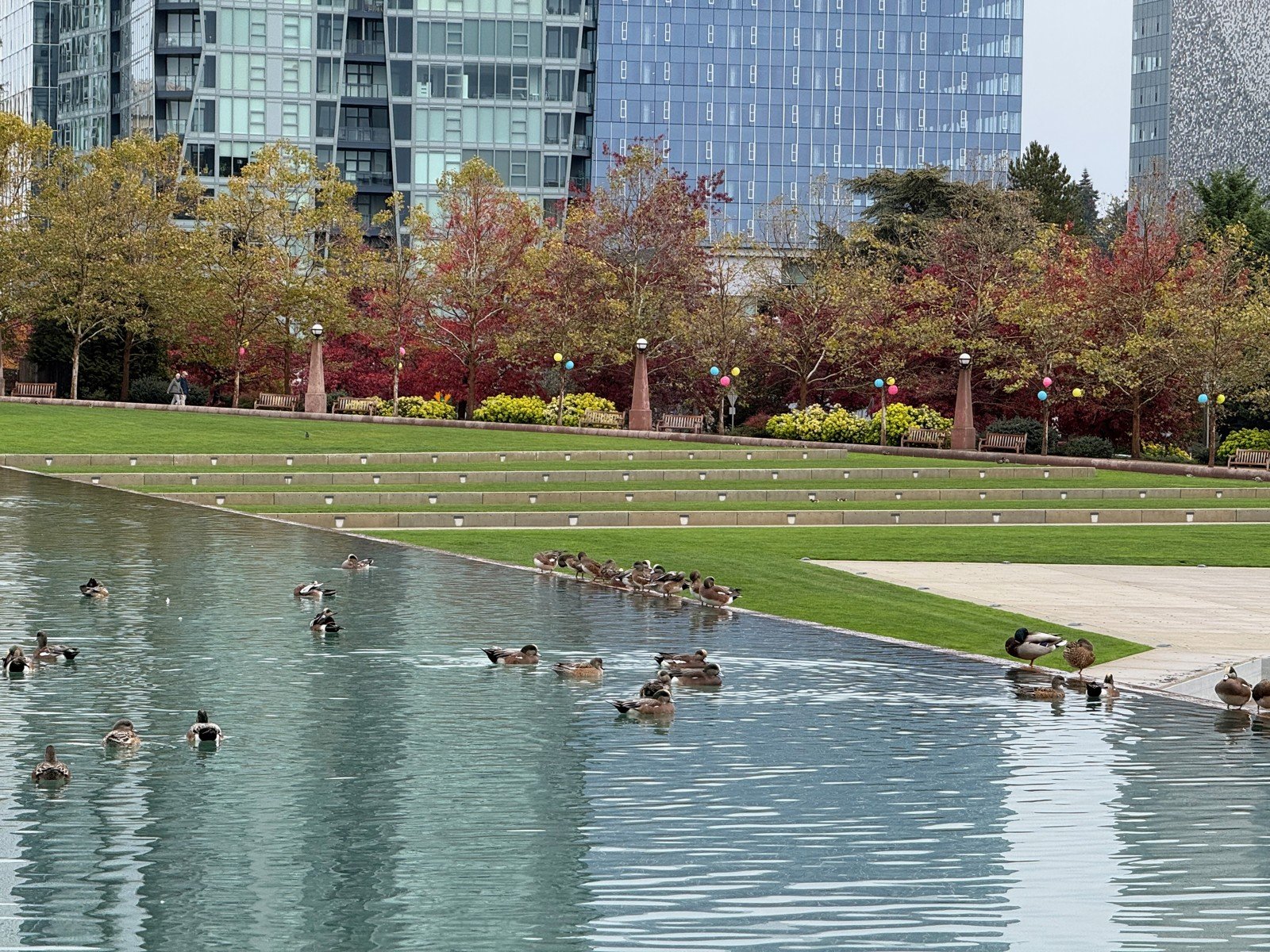
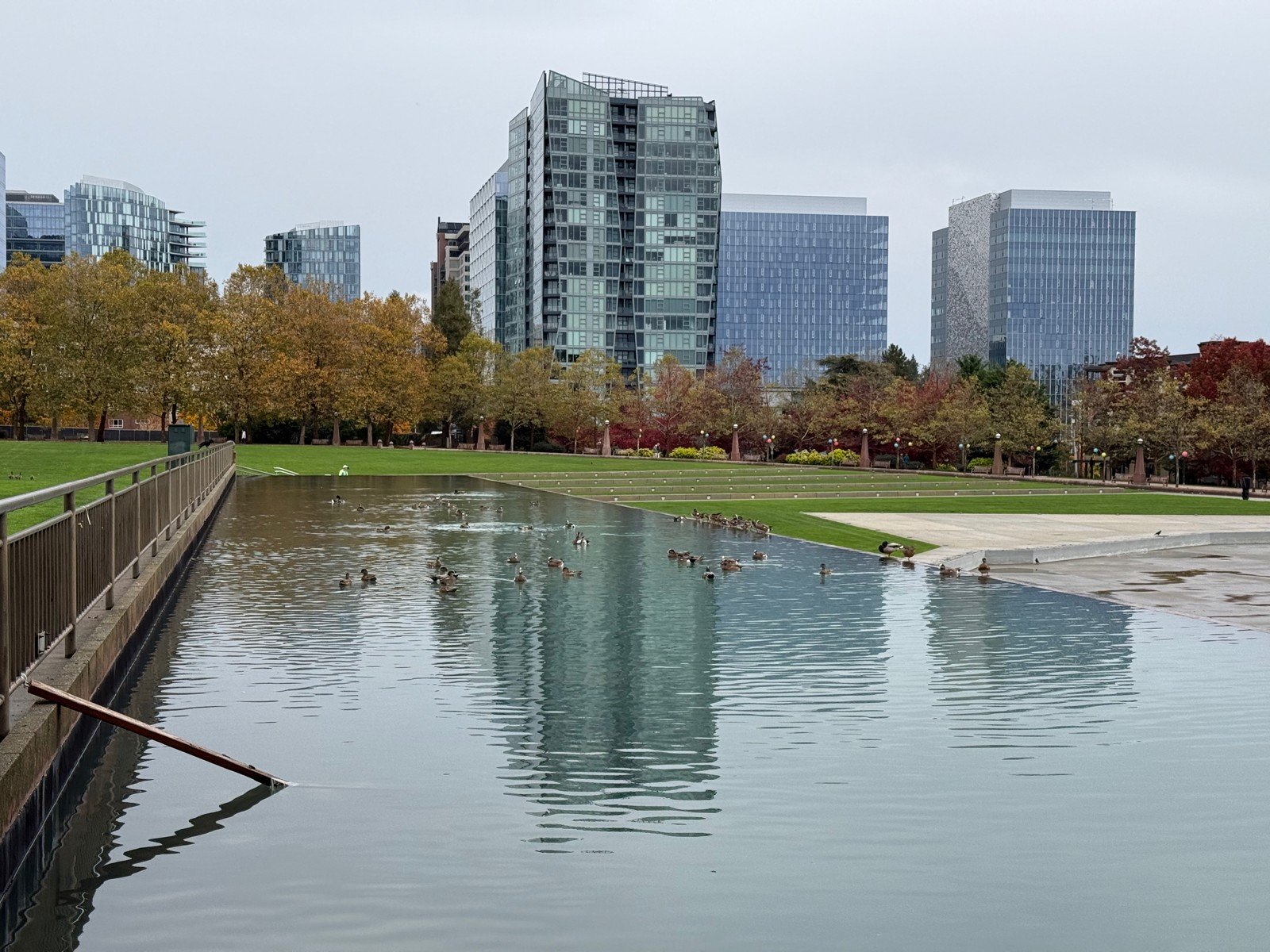
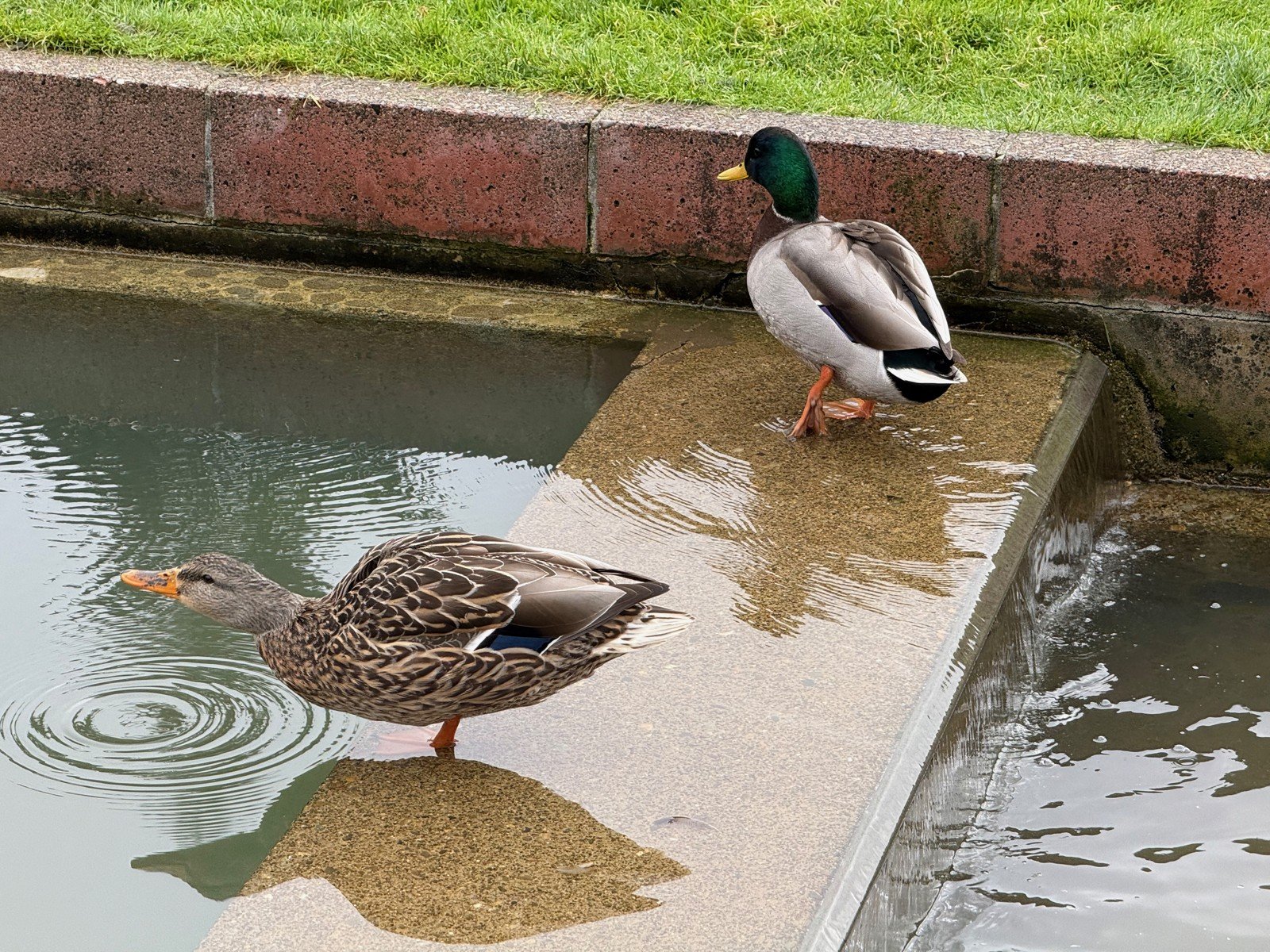
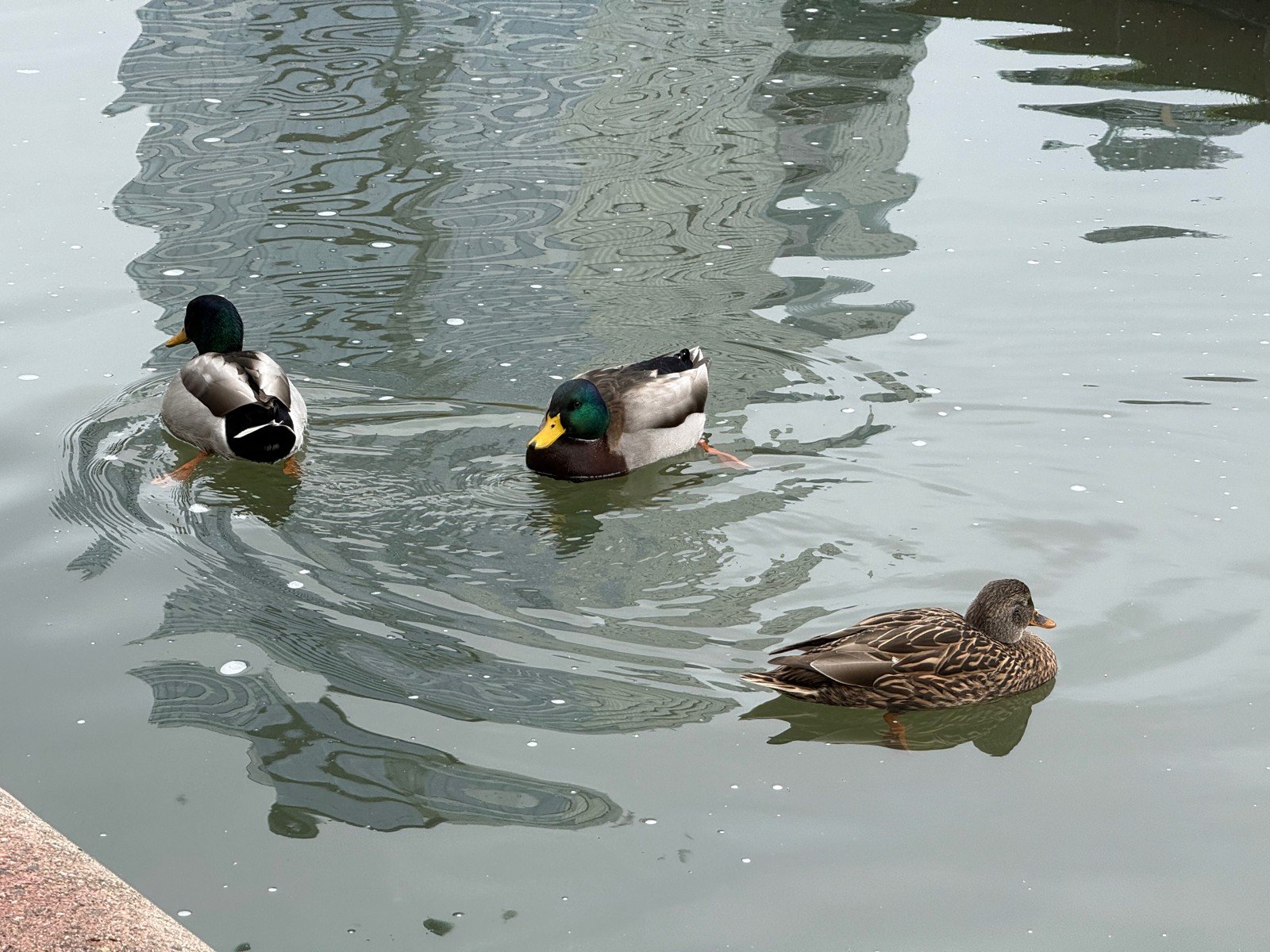
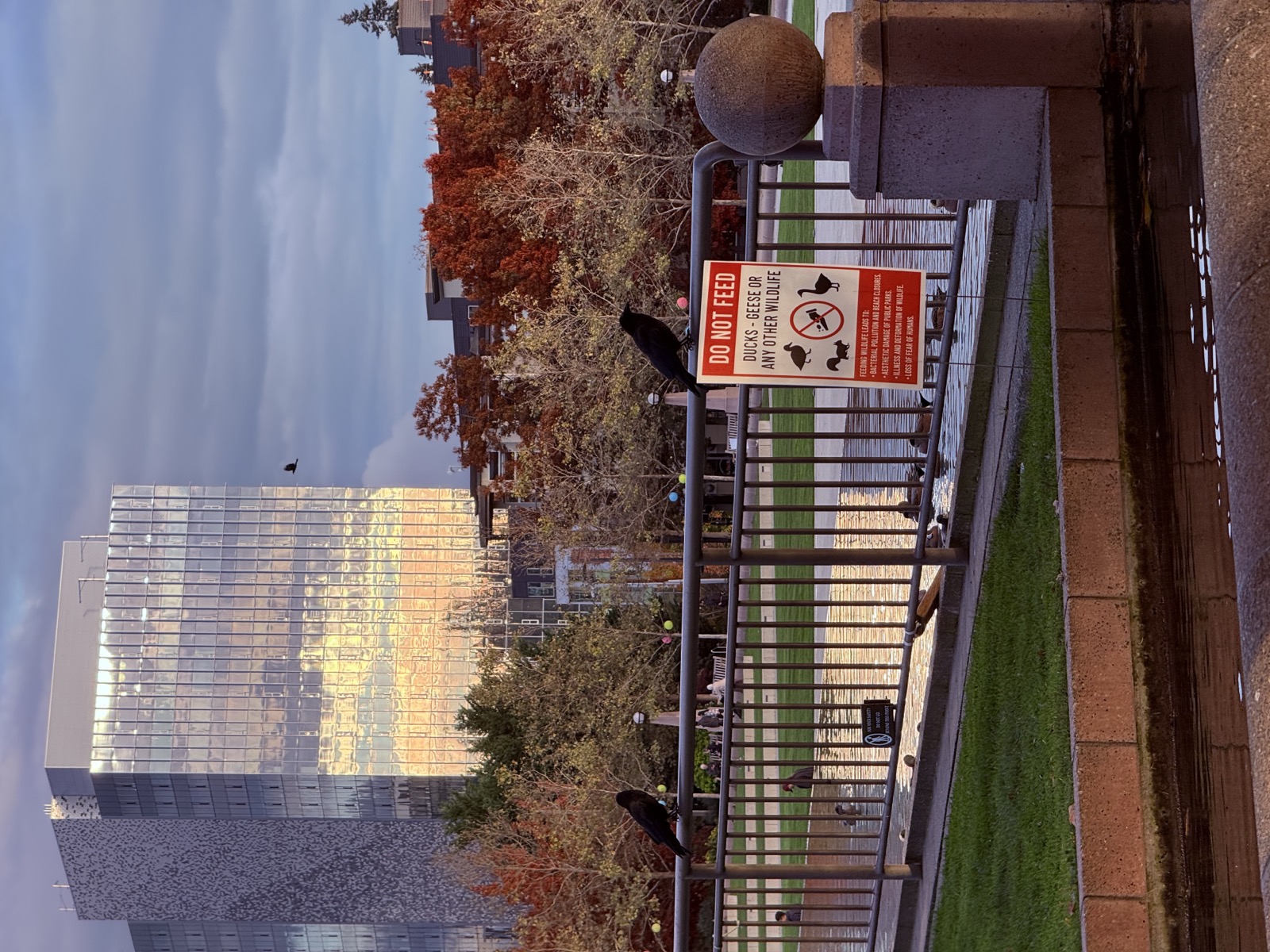
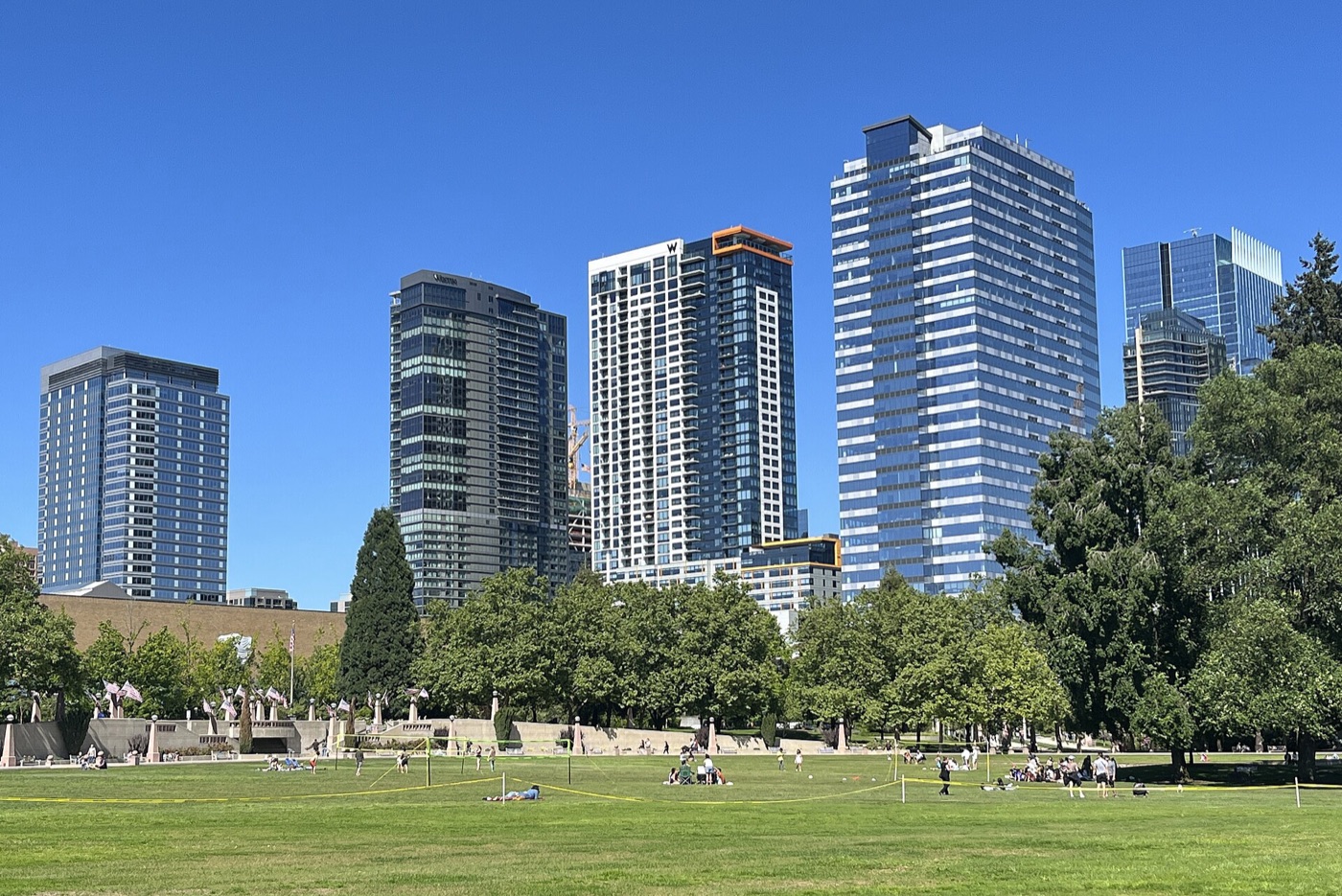
The 10-acre lawn in the middle has no fixed use, so it holds whatever people bring: a picnic blanket, a game of catch, a net strung up for the afternoon.
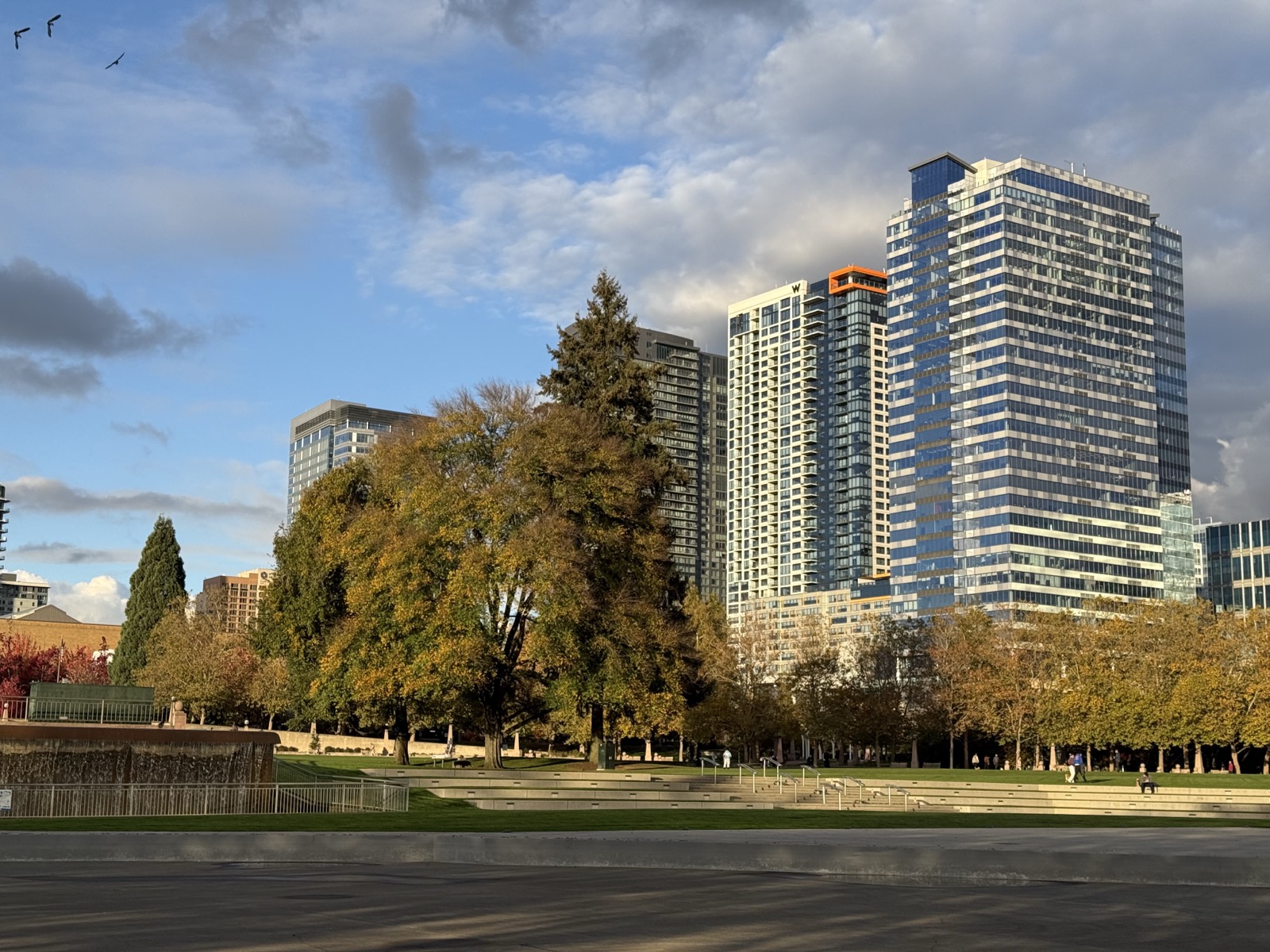
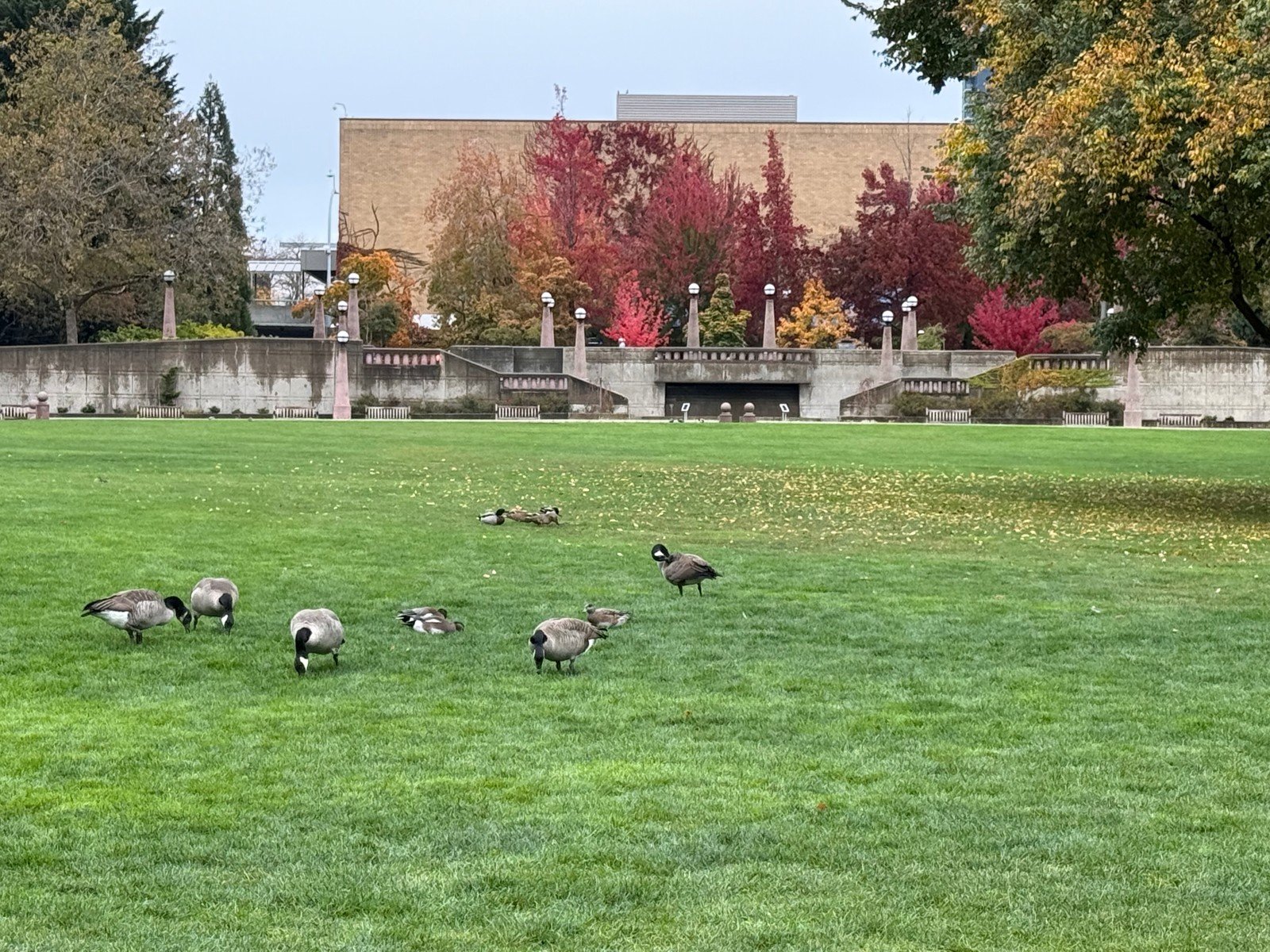
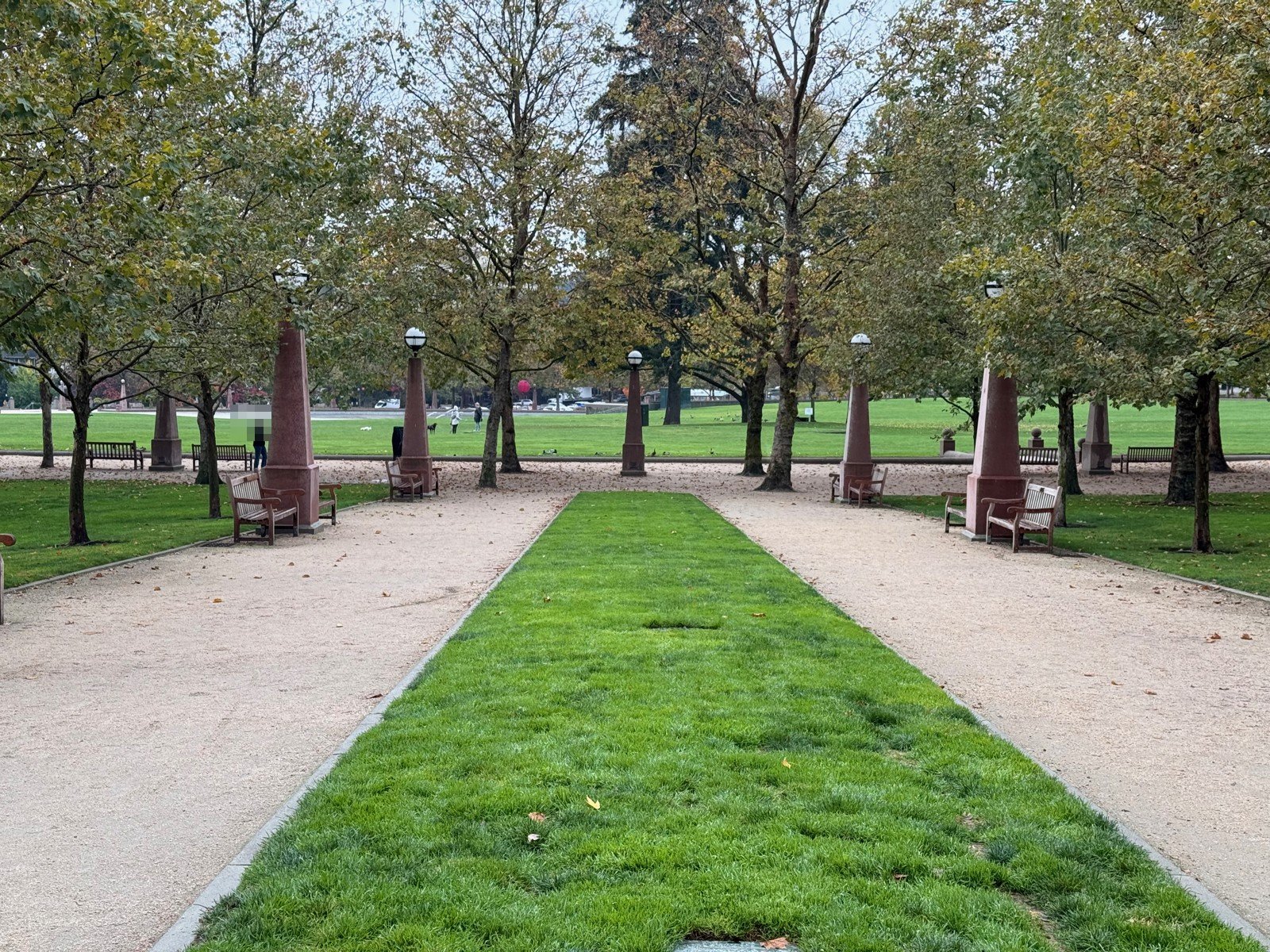
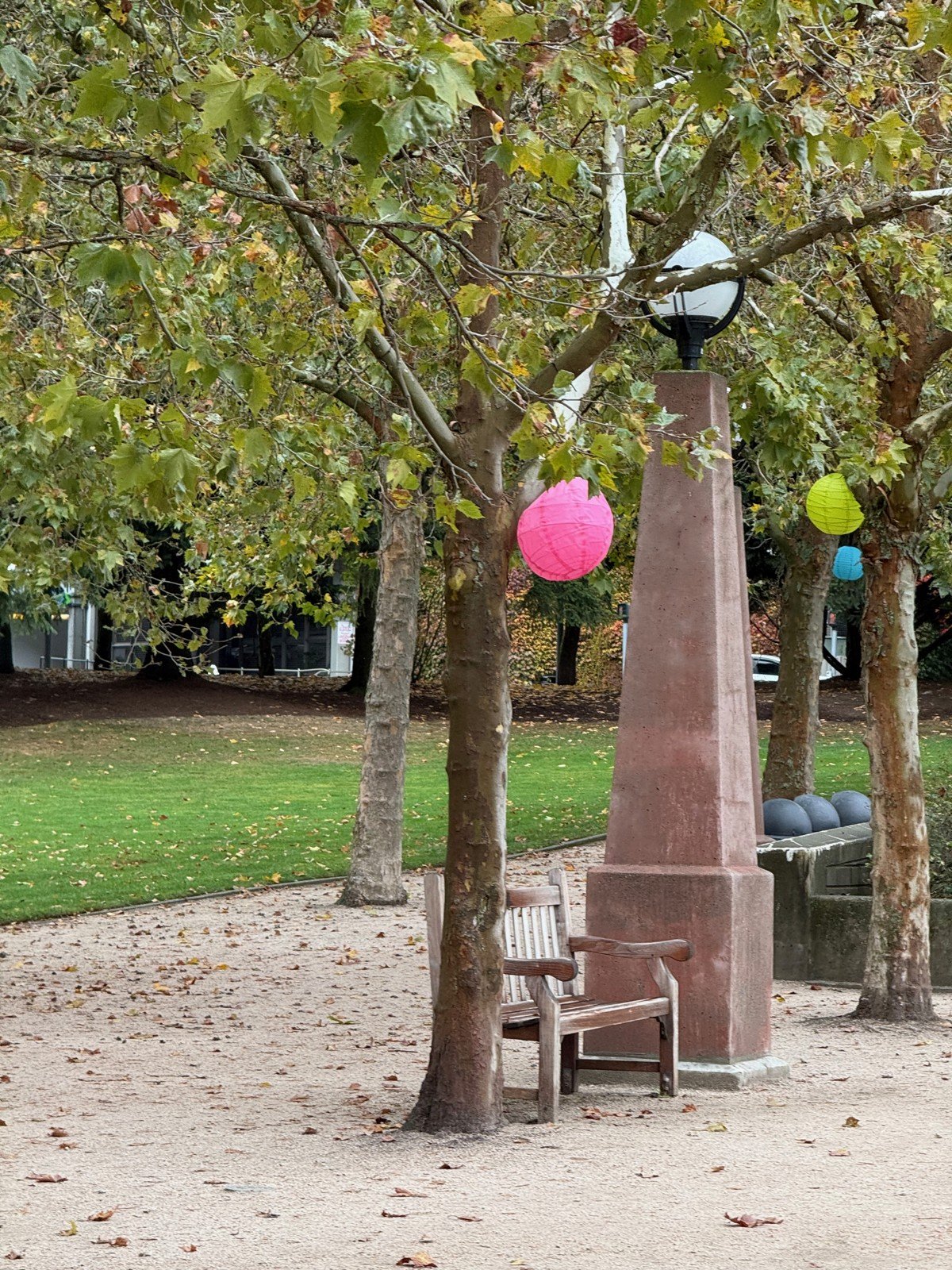
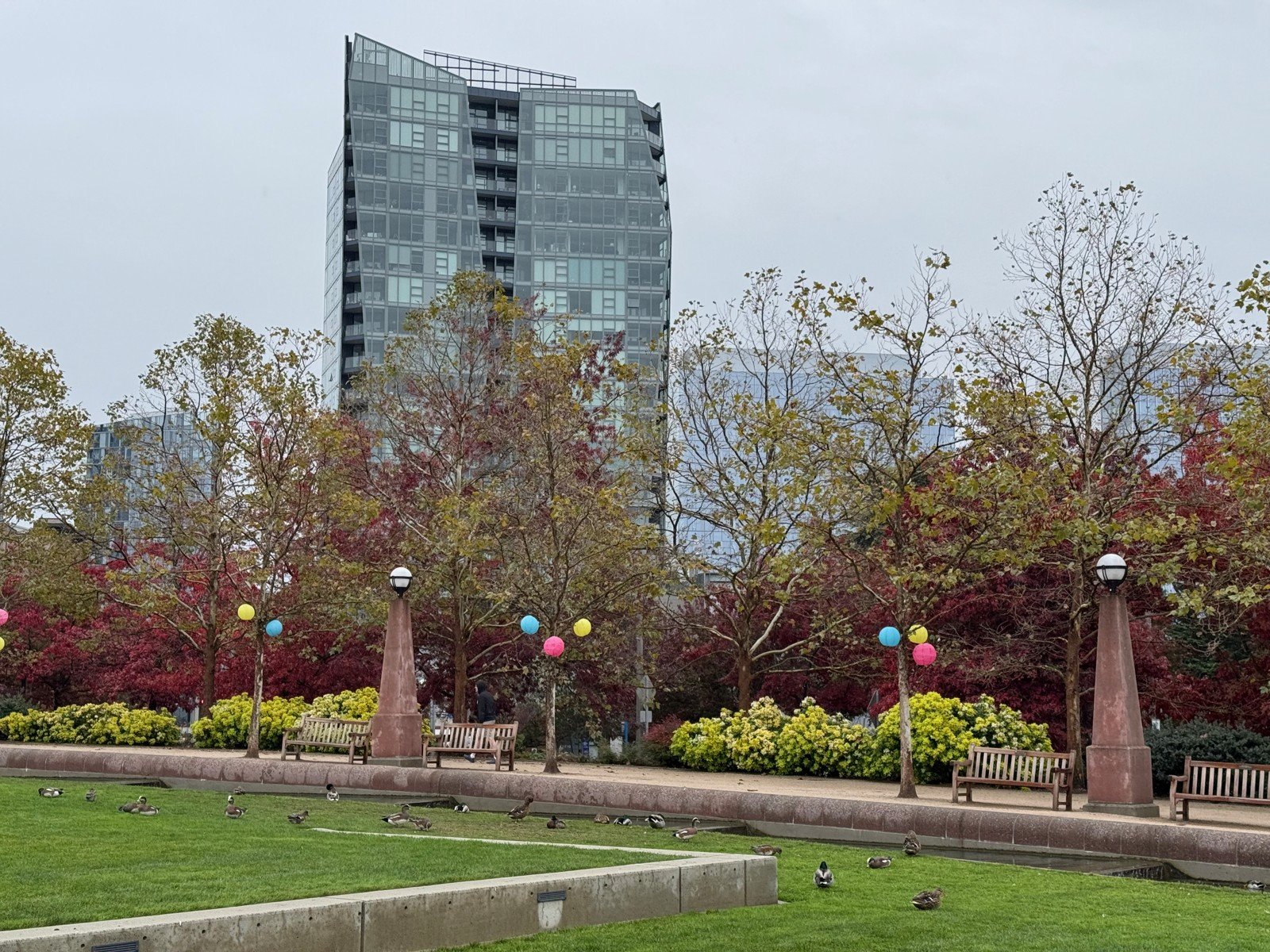
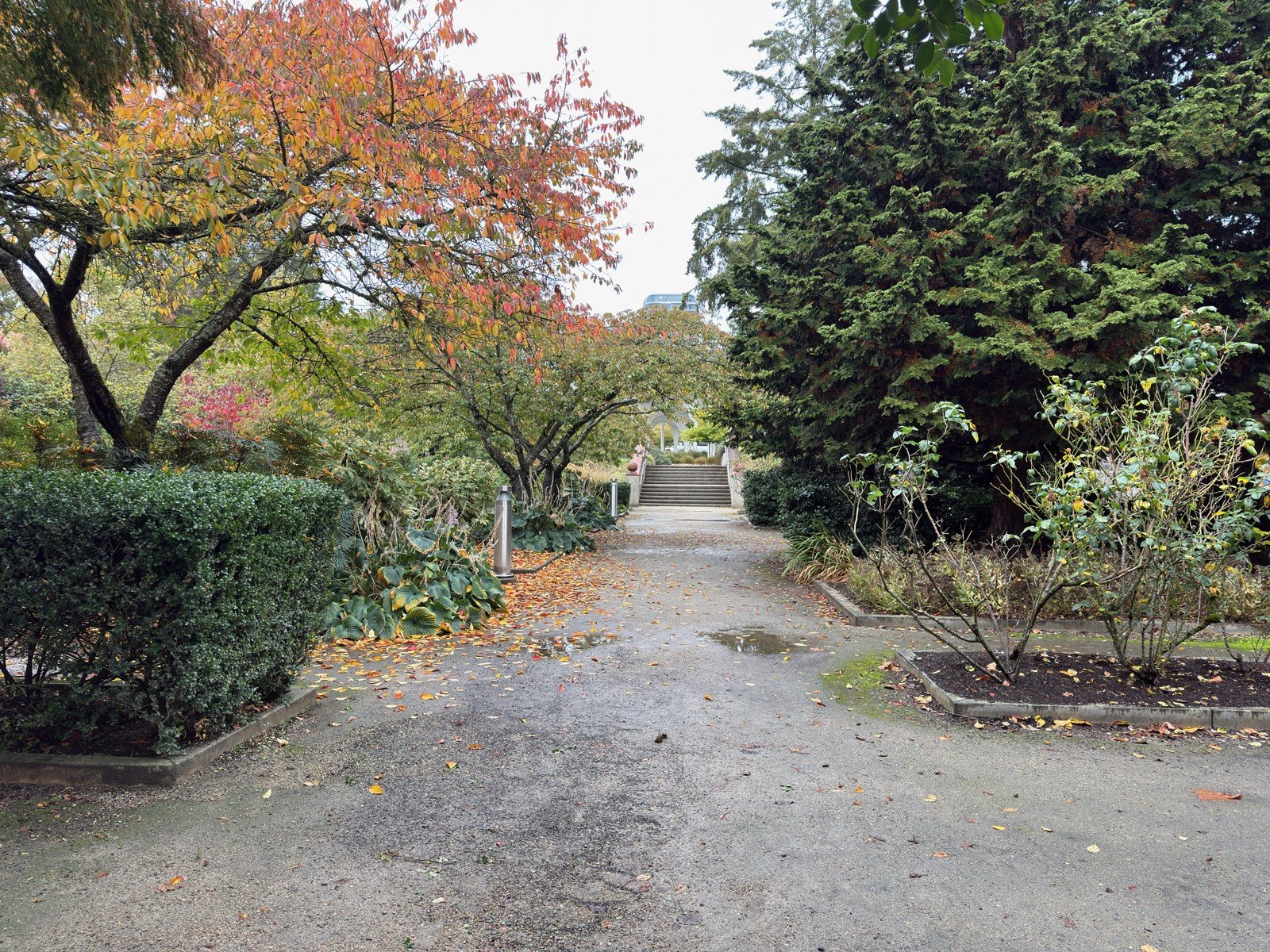
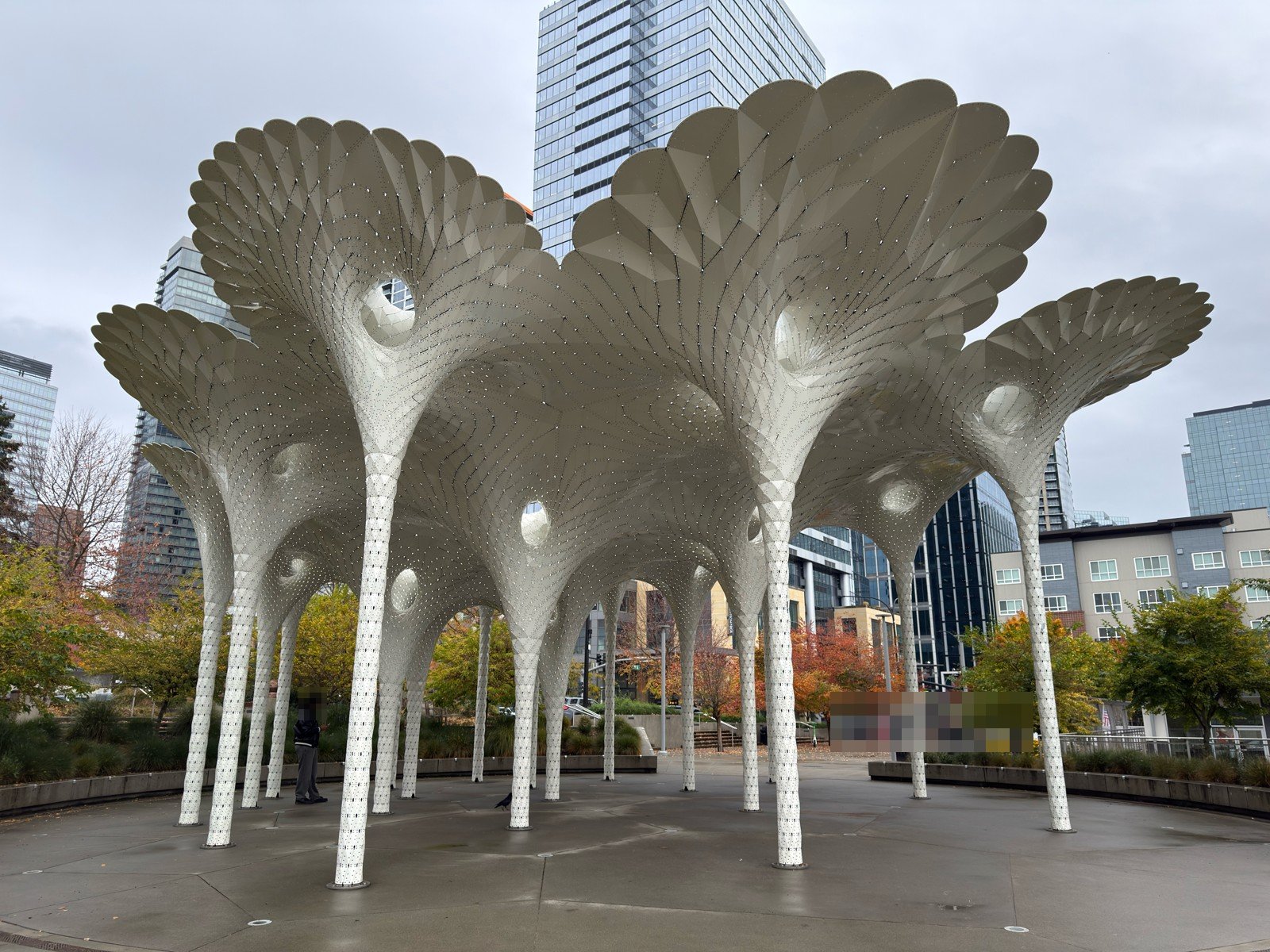
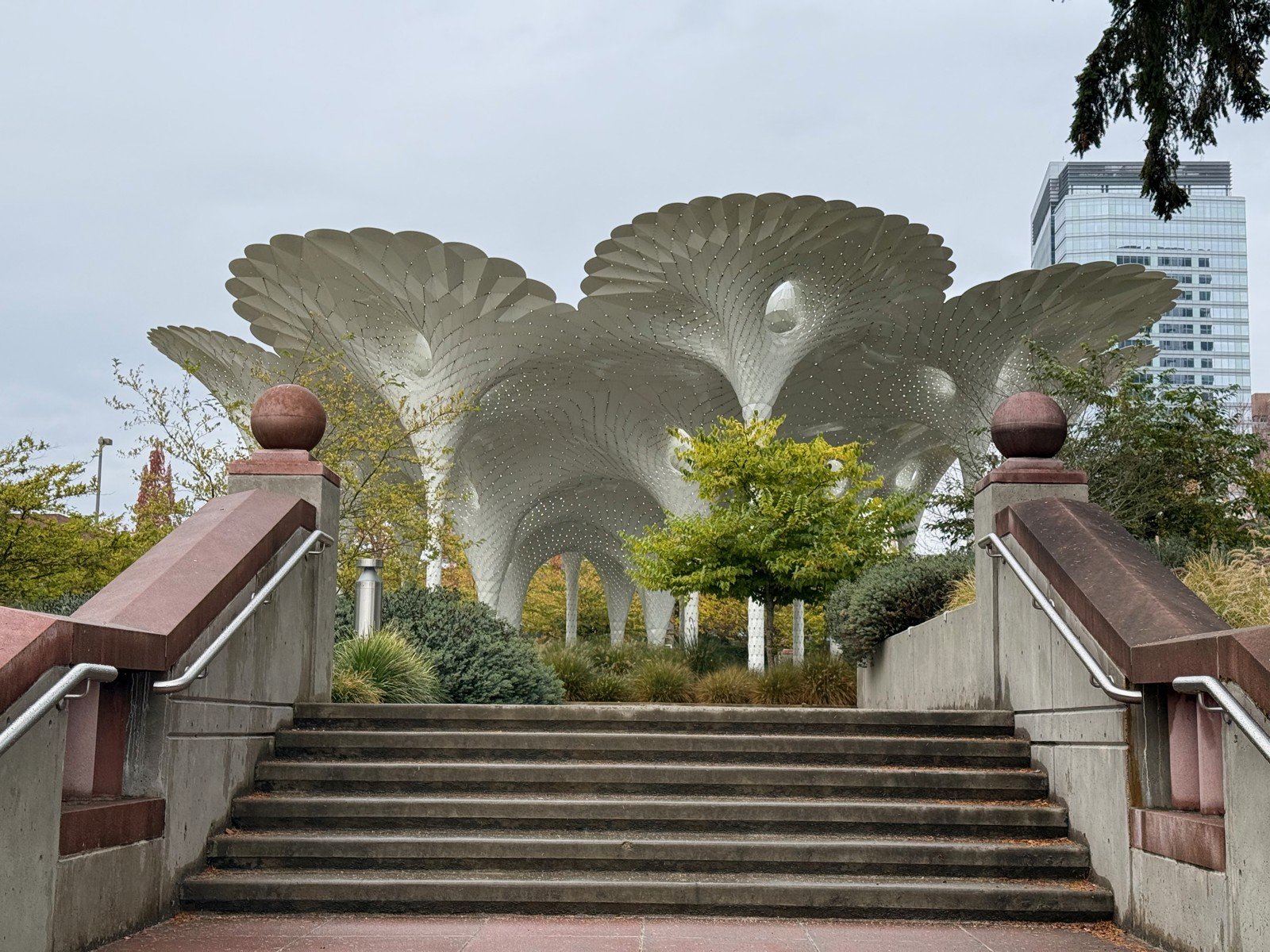
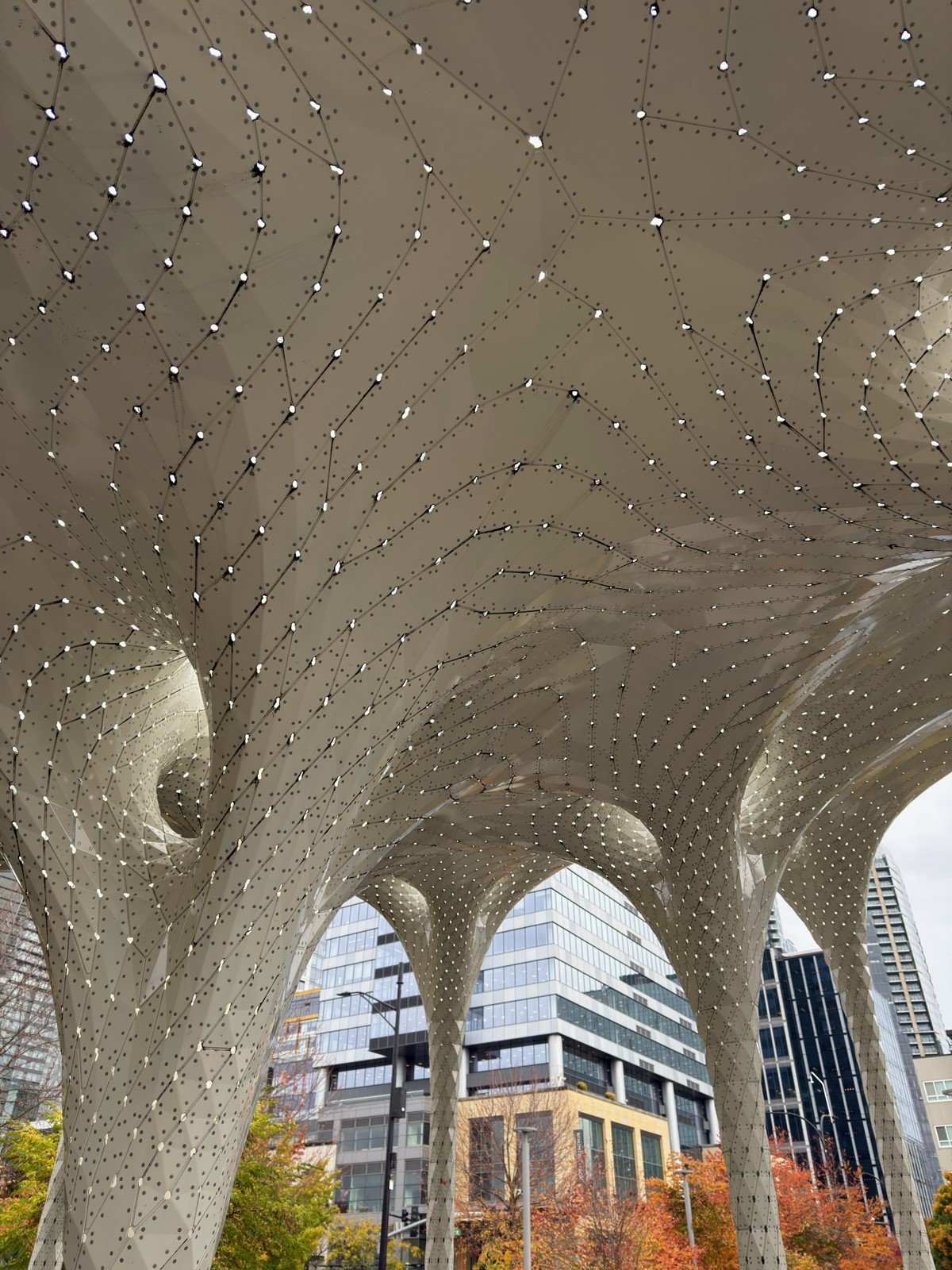
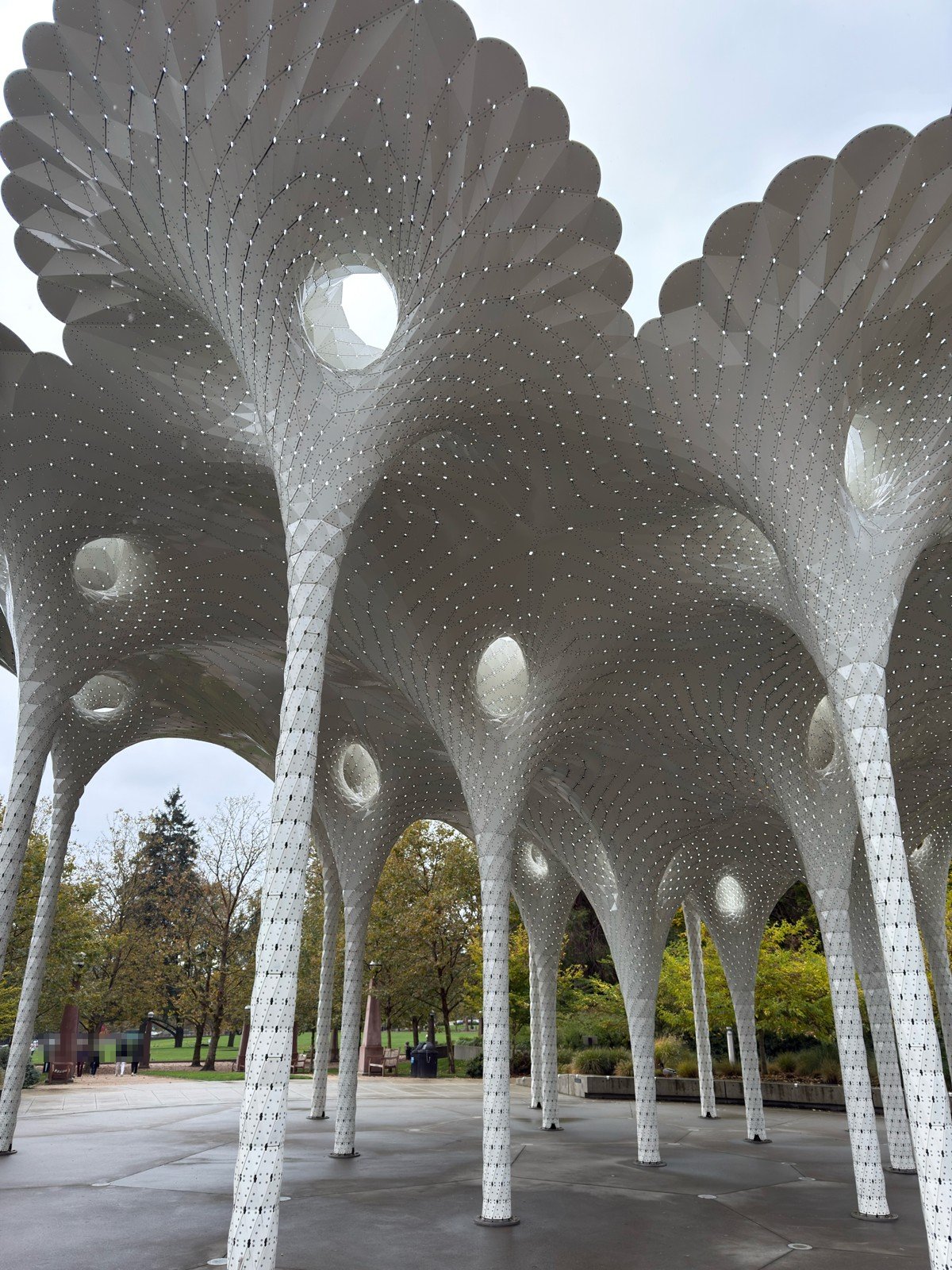
At Bellevue Way and NE Fourth Street, Piloti by Marc Fornes of THEVERYMANY rises into a canopy of fluted columns. You can walk underneath it; openings in the aluminum filter daylight onto the plaza below. The gateway opened in June 2021 and the sculpture came later. Its seating, water feature and art are part of the Grand Connection, the walking route the city is building from Meydenbauer Bay through downtown and over I-405. The city's Piloti page and the artist's gallery show it from above and underneath.
This corner took longer than the circle. In 2019 city staff described an entrance that was easy to miss from downtown, and the Parks Board had asked for one that felt like a park, with visible greenery and art that drew people in. The June 2019 board packet records how the design changed. Construction began in 2020.
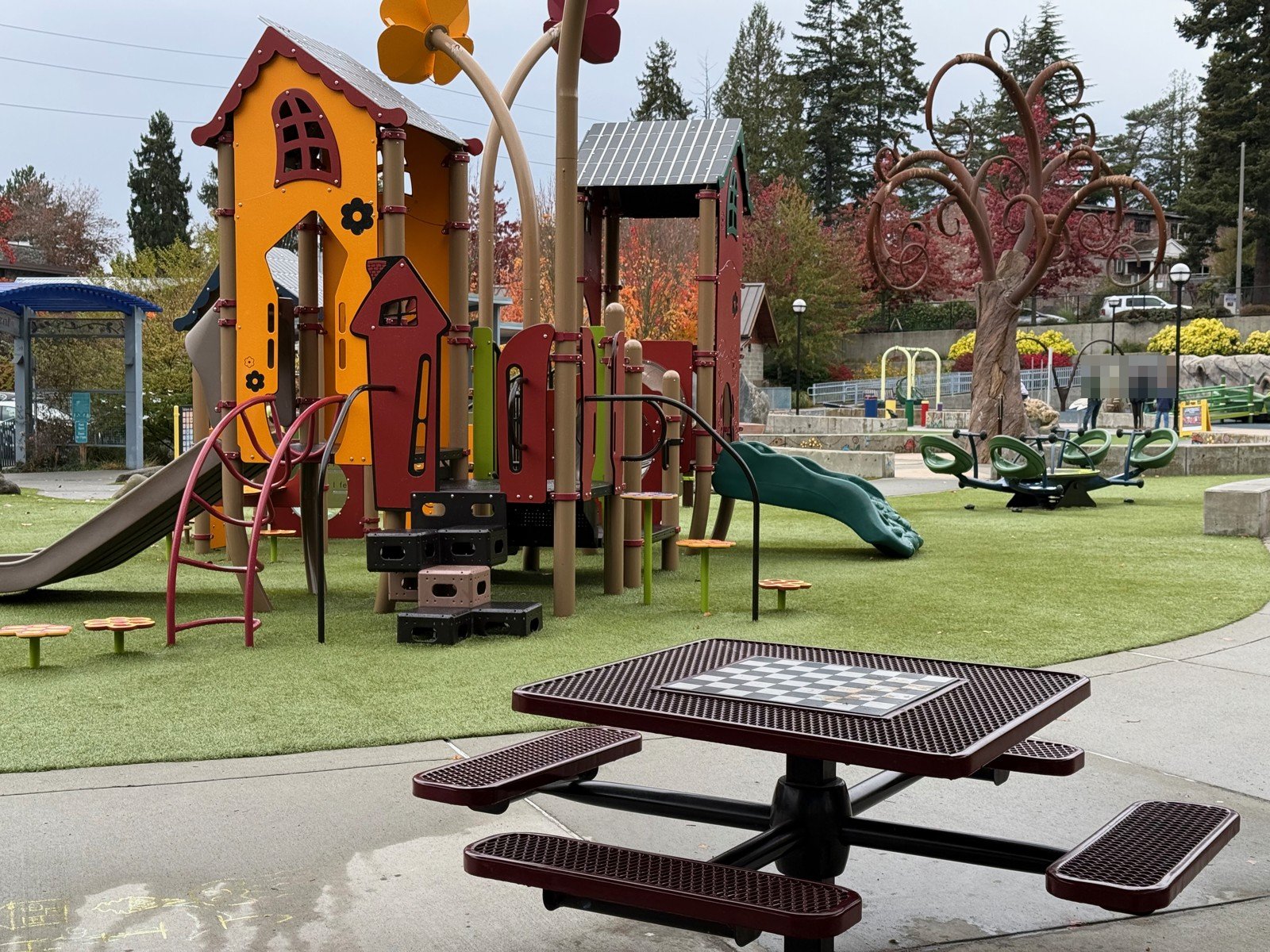
On the southwest side, the city and Bellevue Rotary built a playground for children of all abilities and their caregivers. When it opened in June 2017, the city described sculptures made for touching and climbing, a music plaza where children make sounds and answer them, and a central "Wisdom Plaza" built around a tree sculpture; its playground page has photographs and a site plan. The playground and the restrooms beside it stay open all year. The spray features run from the Friday of Memorial Day weekend through Labor Day, 10 a.m. to 8 p.m.
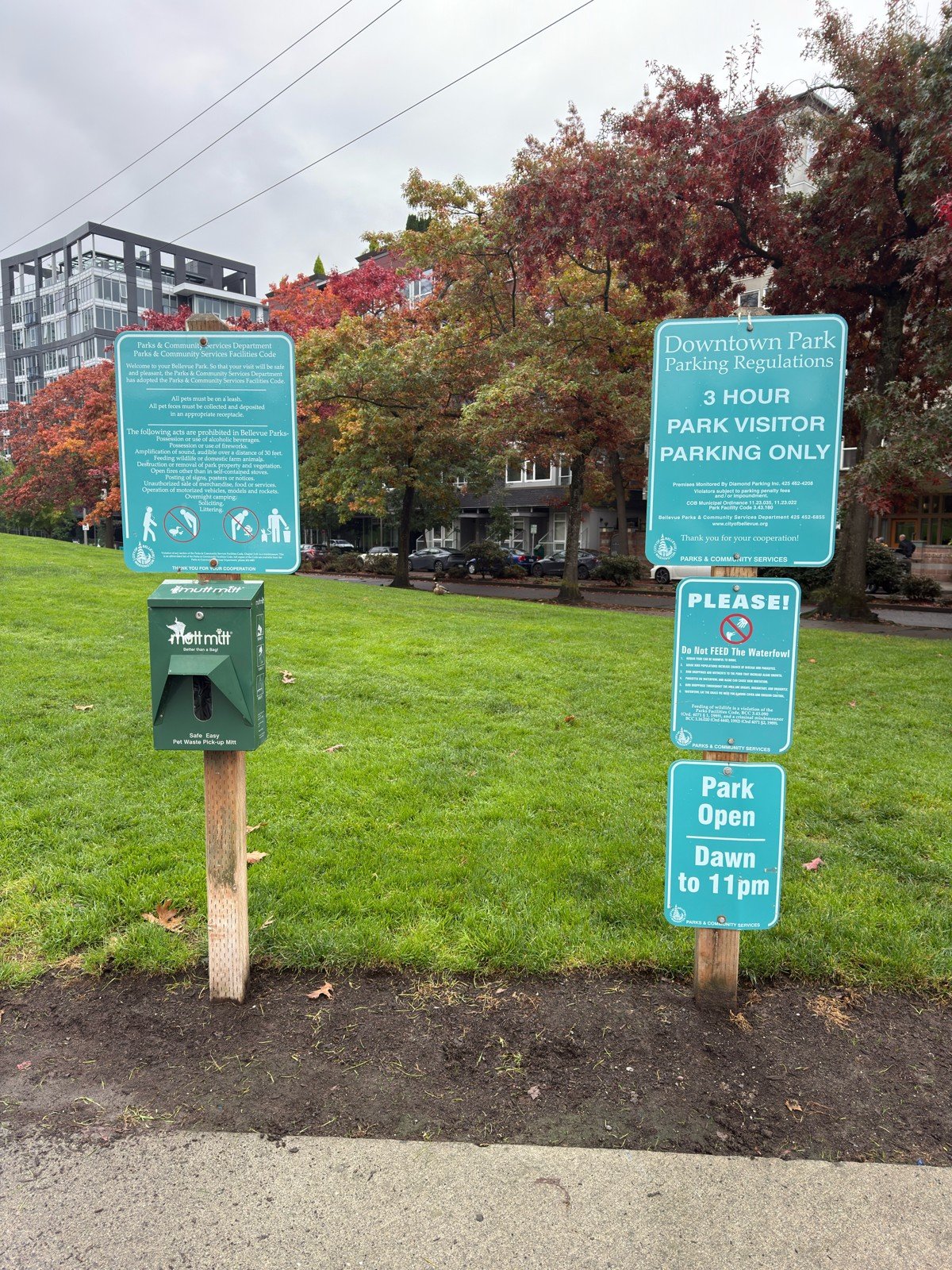
Visiting: the park is open from half an hour before sunrise to 11 p.m. Parking, limited to three hours, is on the west side: the main lot off 100th Avenue NE, mid-block between NE Fourth and NE First streets, and a smaller lot on NE First Street near 100th. The city park page posts notices.
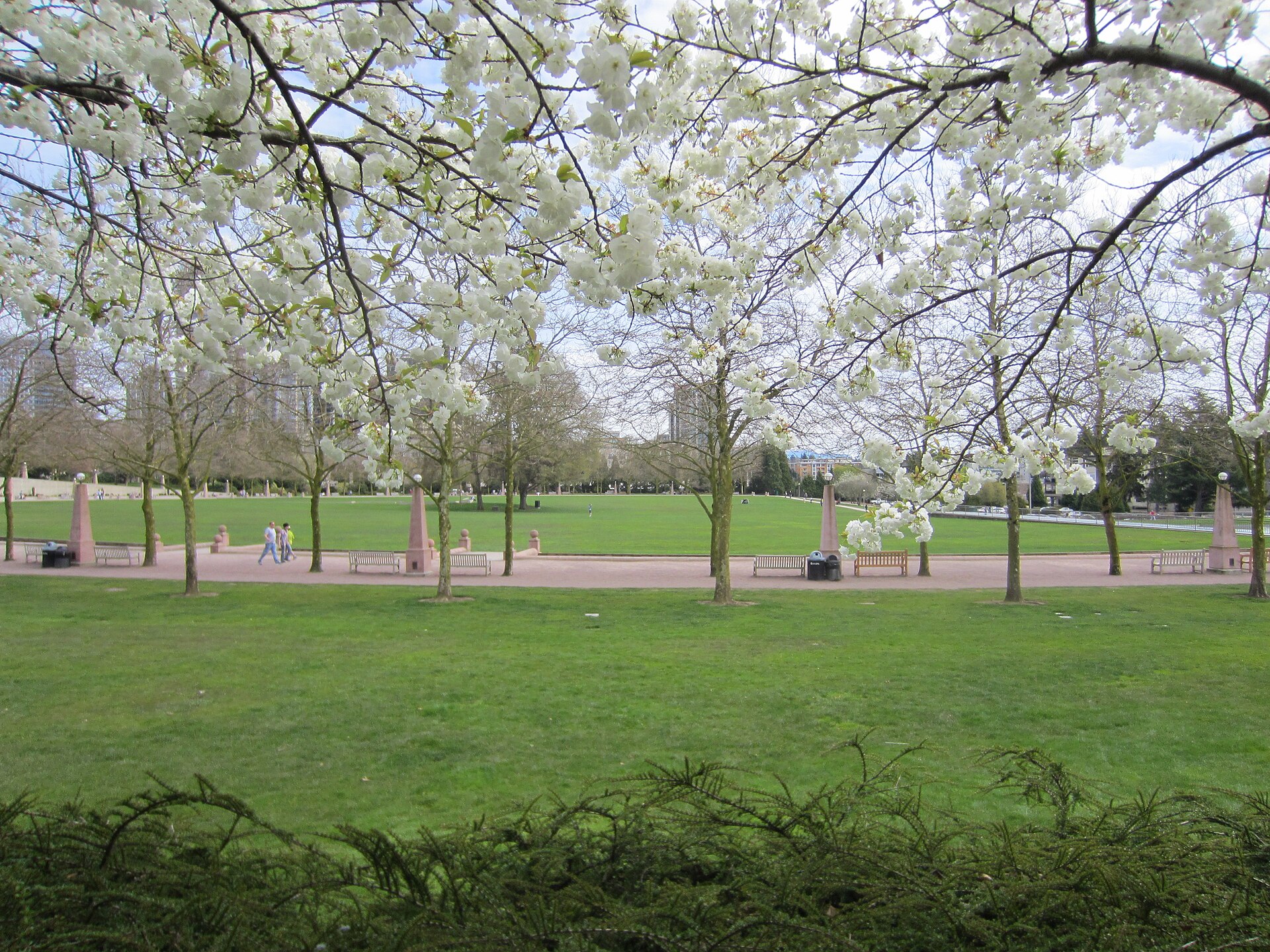
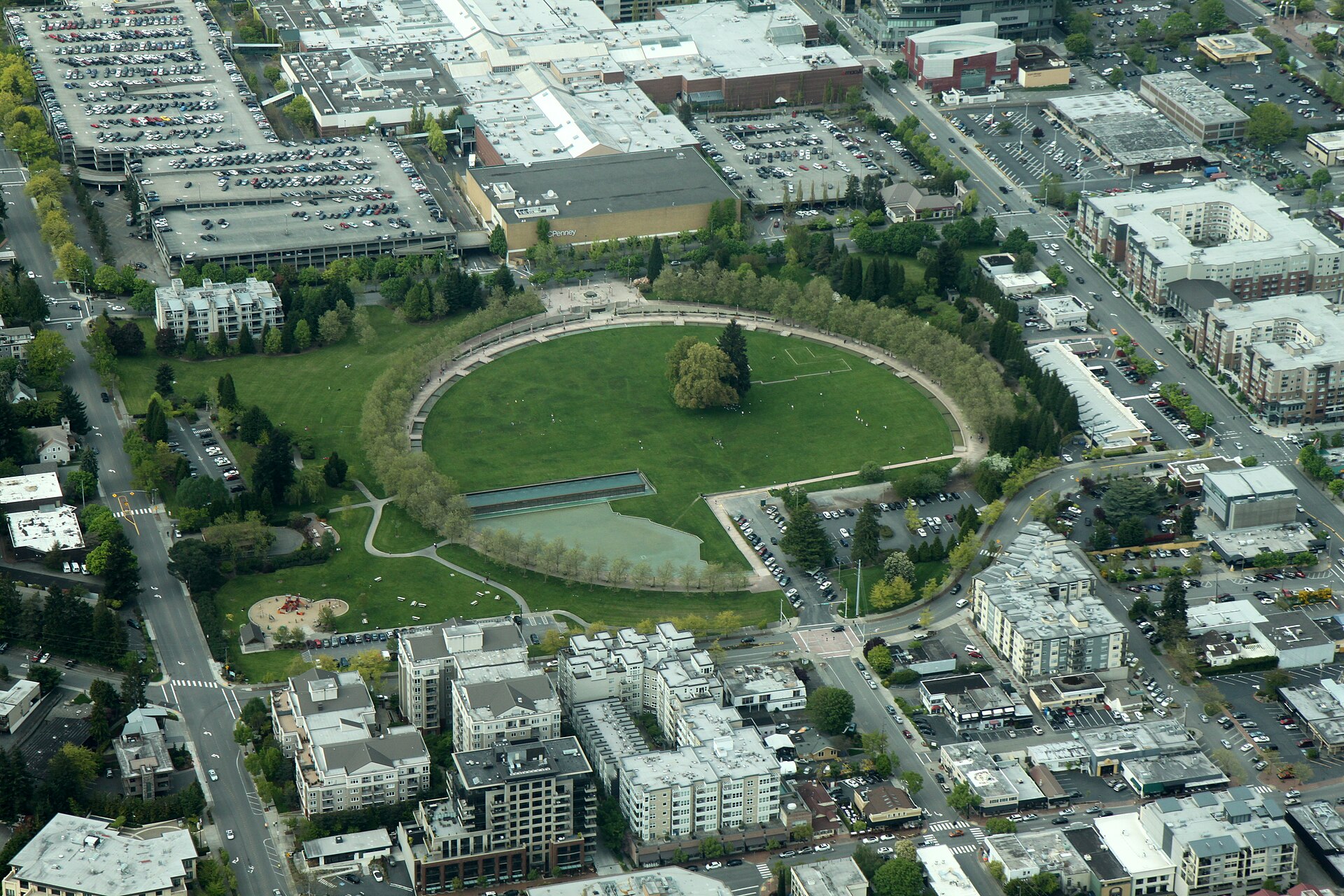
The circle in the opening photograph was missing its southeast quarter until 2017.
Bellevue bought 17.5 acres from the Bellevue School District in December 1983. The next year a park committee judged 67 entries to an international design competition and picked Beckley/Myers of Milwaukee over two other finalists, EDAW of Seattle and Jongejan/Gerrard/McNeal of Bellevue (the finalists were named in Architecture, August 1984, before the final round). The Council approved the master plan that year. The city wanted a quiet park for walking and people-watching that would still look like nowhere else: a tree-lined ring around open ground, with water at the south end and smaller gardens outside the circle. The city's 1997 report reproduces the winning drawing and the competition model.
The park went up in pieces, as the city says the master plan "laid out several phases of construction." The northeast quarter came first, after a private fundraising drive chaired by John Ellis; the west side followed a city parks bond and was finished in 1990. That left three quarters of a circle, with parking where the last arc should have been. The long wait for that arc was not planned: the 1997 report blames "lack of land" and "lack of budget", and in 2016 project manager Ken Kroeger told the Bellevue Reporter the city "just didn't have enough money to complete it."
In the fall of 1996 the mayor appointed a citizens' committee, again chaired by Ellis, to revisit the plan. Three questions in the review shaped what stayed out of the circle. Its report, pages 21–23, records what the committee decided:
| Idea considered in the 1997 review | Committee recommendation |
|---|---|
| Put the Bellevue Art Museum inside the park | Keep a museum outside the boundary; a large building and its access needs would overwhelm the park. |
| Build an amphitheater for more than 3,000 people | Favor a small bandstand and flexible event space; a large venue would require extensive fixed facilities and parking. |
| Provide parking for park users | Replace the small lot with on-street parallel parking and one terraced lot along 100th Avenue NE, with views kept open across the park. |
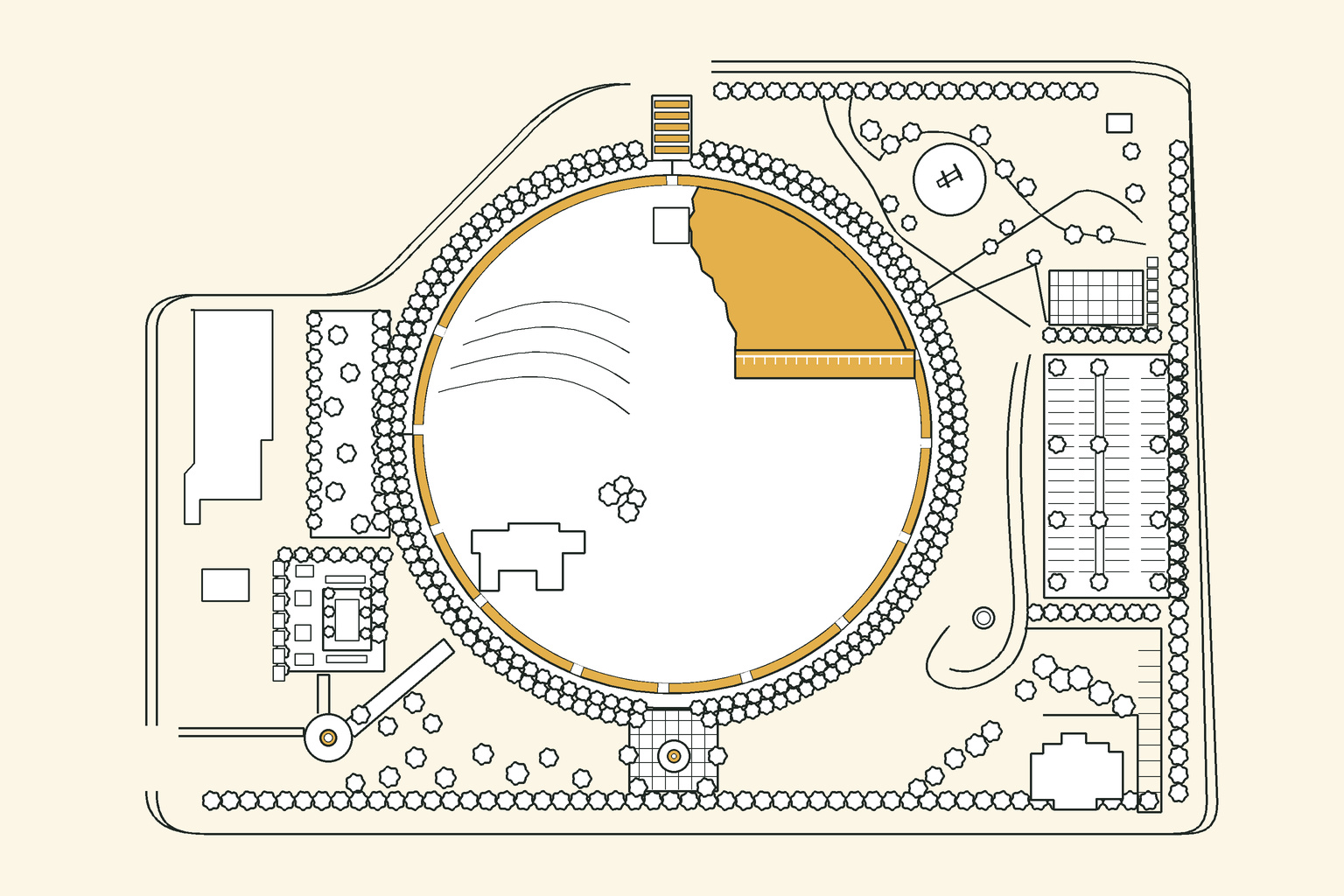
The city's 2015 comparison board shows how the adopted plan changed from there to the version built in 2017.
Bellevue buys 17.5 acres from the Bellevue School District.
A park committee judges 67 entries to an international competition and picks Beckley/Myers of Milwaukee. The Council approves the master plan.
The northeast quarter opens after a private fundraising drive; the west side follows a city parks bond. The southeast quarter stays unbuilt.
The citizens’ committee retains the circle, recommending against a museum inside the park and an amphitheater for more than 3,000 people.
The final promenade segment replaces the old vehicle entrance and parking. Inspiration Playground opens alongside it.
The Bellevue Way entrance opens after the Parks Board reviews four layouts. Piloti is installed later.
The 2017 work rebuilt much more than the missing arc. It added the southern entrance and its water feature, terraced seating, stairways and accessible paths. It also closed the parking off NE Second Street and enlarged the lot off 100th Avenue NE, all while the expanded playground went in next door.
Council authorized up to $17,948,411.25, including sales tax and contingency, for Ohno Construction. This is an authorization rather than a final spending total. Council minutes.
The city credits Bellevue Rotary’s community fundraising and grants. This playground figure overlaps the combined construction scope beside it. City announcement.
The two figures cover overlapping work, so they don't add up to a total. The Council authorized the construction contract on 20 June 2016, in a 6–0 vote on its consent calendar.
Voters approved the 2008 Parks & Natural Areas Levy, a property-tax measure, with Downtown Park on its project list. The levy's project table set it at $10 million in 2008 dollars, half from the levy and half city match, plus $150,000 a year for upkeep split the same way. The city's 2015–16 capital plan added real estate excise tax, a tax on property sales, to the park project.
For Inspiration Playground, Bellevue Rotary ran the community fundraising, which the club called its largest project ever. In June 2016 it handed the Council a check for $3,351,861. The state added a $1 million capital-budget allocation and a $500,000 Washington Wildlife and Recreation Program grant.
The northeast gateway had its own money: a Washington Department of Commerce capital grant, noted on the city's Piloti page, and $8.25 million in total in the city's 2019–2020 capital plan.
The 2017–18 budget expected the new work to add $185,000 a year in upkeep for the park and $139,000 for the playground, paid from the levy. The city budgets maintenance by program across all its parks, so it publishes no yearly cost for Downtown Park alone. To report a problem, call 425-452-6855 or use MyBellevue; to reserve the plaza or terraced seating, call 425-452-6914 or use the rental page.
As of Thursday 29 October 2026, the Council is reviewing the city's next two-year budget and six-year capital plan. It held the third and final public hearing on Tuesday 27 October 2026; deliberations are scheduled for 10 November and adoption for 17 November.
Park projects nearby, 2027–2032
The preliminary capital plan has no new project for Downtown Park, which was finished in 2017. A major repair here, such as replacing the playground, would come from the citywide Parks Renovation & Refurbishment Plan: $38.9 million over 2027–2032, $6.4 million of it in 2027, for "roof, HVAC, dock and playground replacements" in every park the city runs.
New downtown park money goes to other sites. Ashwood Park gets $9.9 million for a new design; its project sheet says park space per downtown resident has fallen from 800 to 100 square feet since that park's 1990 plan. A small park on NE Second Street has $0.8 million for planning and design in 2031–32, and the project is on hold. At the waterfront end of the Grand Connection, Meydenbauer Bay Park's second phase has $32.3 million, including the corridor's park entry.
To weigh in, write to [email protected] with the subject "Written Communications" by 3 p.m. on a meeting day.
| Body or group | Role |
|---|---|
| Bellevue Parks & Community Services staff | Day-to-day care and delivery of park projects. |
| Parks & Community Services Board | Appointed residents who advise the Council on planning, renovation and stewardship across the city's parks. |
| City Council | Policy, budgets and authorizations such as construction contracts. |
| Arts Commission | Public-art decisions; helped select the artist for the northeast gateway. |
| Bellevue Rotary | Playground fundraising partner. |
| Bellevue Downtown Association | Produces programs including the seasonal ice rink. |
The city's Parks Board roster, checked 23 October 2026, lists six members and one vacant seat: Rowena Clima, chair; Michelle Valverde, vice-chair; Steve Chianglin; Eric Drever; Elizabeth Kronoff; and Stephan Hobe. Councilmember Naren Briar is the Council liaison.
Residents can write to [email protected] or speak at a board meeting, held the third Wednesday of each month at 6 p.m. at City Hall. The board advises on parks citywide; sponsors and event organizers don't own the park.
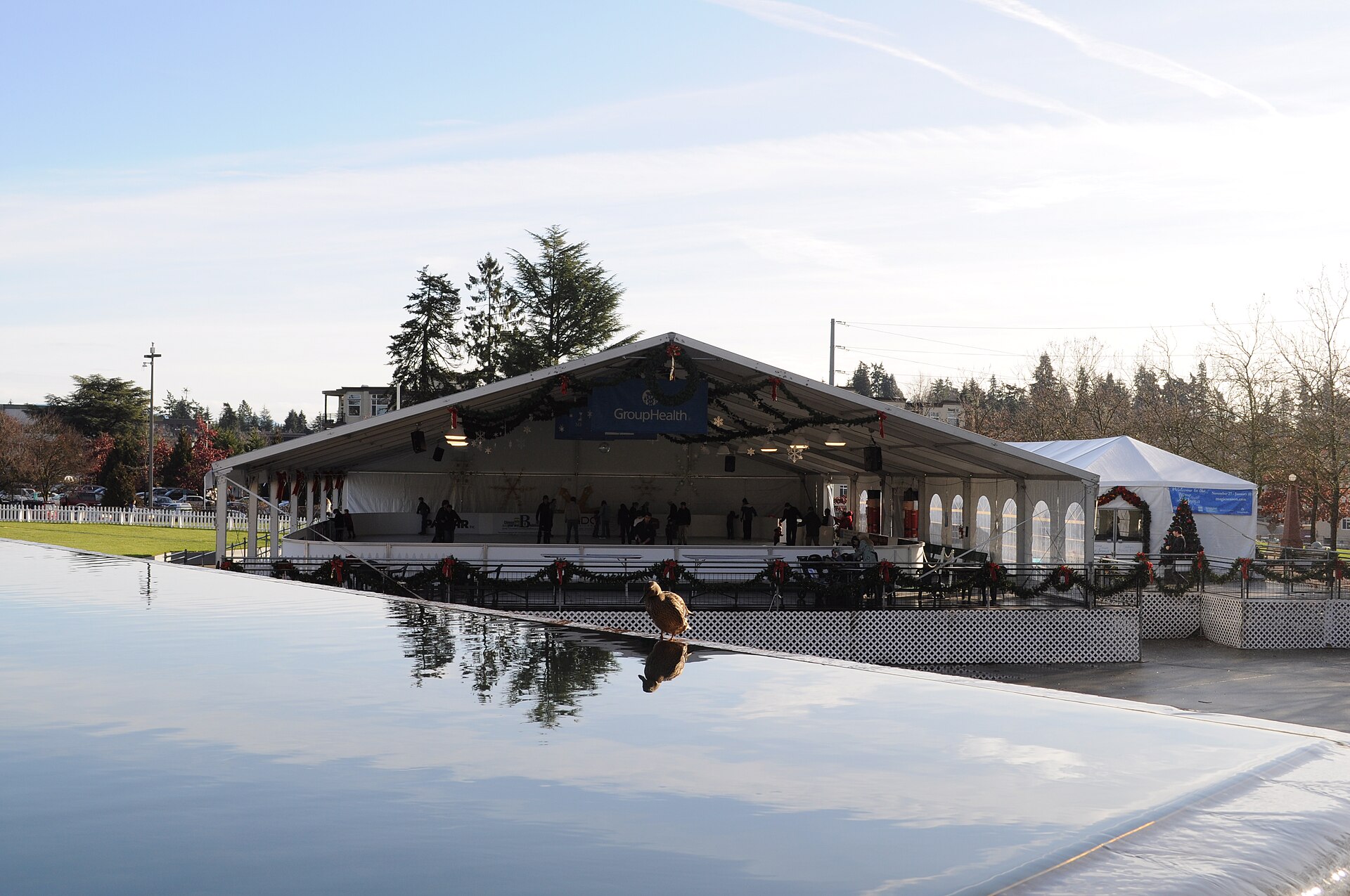
Winter brings a temporary skating rink, and summer brings outdoor movies and large gatherings on the lawn. The Bellevue Downtown Association produces the rink, with tickets and session times on the rink website.
| Season | At the park |
|---|---|
| Spring | All in for AutismA run/walk based at the park, organized by Bellevue Breakfast Rotary. |
| Early summer | Paws & Pride Dog WalkA community dog walk produced by BDA and Eastside Pride PNW. |
| Independence Day | Bellevue Family 4thLive music, family activities and fireworks. |
| Summer | Movies in the ParkFree outdoor movie nights; the city publishes the season’s films and weather notices. |
| Late fall–winter | Downtown Ice RinkSeasonal skating; tickets, opening dates and session times from the organizer. |
Each season's dates are on the BDA events calendar and the city calendar; both cover other places too, so check the location. To organize an event, start with the city's special-event rules: one with 500 or more participants, or that affects streets, rights of way or public parking, or needs police, traffic or fire support, needs an Application of Intent at least 90 days ahead.
These are a few minutes from the south and east entrances, near enough to carry back to the lawn. Each link goes to the business's own page.
For Bellevue Square, leave by the north side and cross NE Fourth Street; Main Street's shops run south through Old Bellevue.
Figures re-read on 23 October 2026. Each figure was read again at its primary source. The city park page gives the 21 acres, the 10-acre lawn, the 240-foot waterfall, the hours and the parking lots; the rental page gives the three-hour limit and the year-round restrooms. The Council minutes of 20 June 2016 record the 6–0 consent vote, the $3,351,861 Rotary check and a contract with Ohno Construction for up to $17,948,411.25, including sales tax and contingency. The June 2017 announcement gives the $20 million and $4.5 million figures and the playground's features. The budget figures come from the 2017–18, 2019–2020 and 2027–2032 documents linked below, the hearing dates from the Council's 23 October roundup and the budget pages. The 1997 report is a scan with no text layer and was read page by page.
Costs that don't reconcile. The 2017 announcement put Complete the Circle at $20 million and the playground at $4.5 million. The 2017 capital plan lists a $12 million Downtown Park Development line, and the 2019–2020 plan carries the playground at $3.8 million in total project cost on the city's own books. These cover different scopes and dates, and no published final account ties them together. The page uses the contract authorization and labels the playground's reported cost. Gifts and grants aren't added into an assumed total, and the $17.95 million figure is a ceiling, not an audited payment.
Still open. Three things weren't found in any public record online: the Council's 1984 vote count on the master plan (no 1984 minutes are posted, and the city's code archive refused the request), the other finalists' drawings, and a current yearly maintenance cost for this park. The page states none of them.
Names and dates that disagree. The city's own pages spell the winning firm Beckley-Meyers; the 1997 report and the 1984 Architecture notice spell it Beckley/Myers, which this page uses. The 1997 report dates the first phase to 1986 and other accounts to 1987, so the page says only that both phases were done by 1990.
Public park and neighboring property. The yellow outline follows OpenStreetMap way 24547844, read on 19 October 2026, including its curved southern edge. It shows the mapped park, not surveyed parcel lines, and the interior labels are approximate. Bellevue Square, the Collection's programs and independently organized events don't own or manage the park.
Roster. The roster is reported as listed. The chair's displayed term still reads 31 May 2026; check later Council appointments before relying on it for tenure.
Events and photographs. The page describes recurring programs by season and links each organizer for current dates. The opening aerial is from 2023, the history aerial from 2012 and the skating photograph from 2010. Those historical views don't show current conditions. Brian's photographs of the waterfall, lawn, Piloti and playground are from 25 and 26 October 2026; the captions date each view. No attendance count is claimed. Business addresses were checked on the businesses' own pages (Santouka on 19 October, Molly Tea in the brand's store locator on 25 October, the rest on 23 October). They're nearby options, not reviews or endorsements.
Read on 23 October 2026 unless a date is given.
Updates and corrections. None so far.
One email when a new story is published, with any corrections. Nothing else.
Places
5 min read
Places
11 min read
Places
5 min read