Where the free shuttle goes, who rides it, who pays for it, and the city's share in the budget the Council adopts on 17 November.
Free
rides around downtown, 8 a.m. to 9 p.m.
6,000
rides a month, on average, 2024 to 2026
$150,000
the city's share a year, about a sixth of the budget
0.03%
of the city's proposed General Fund
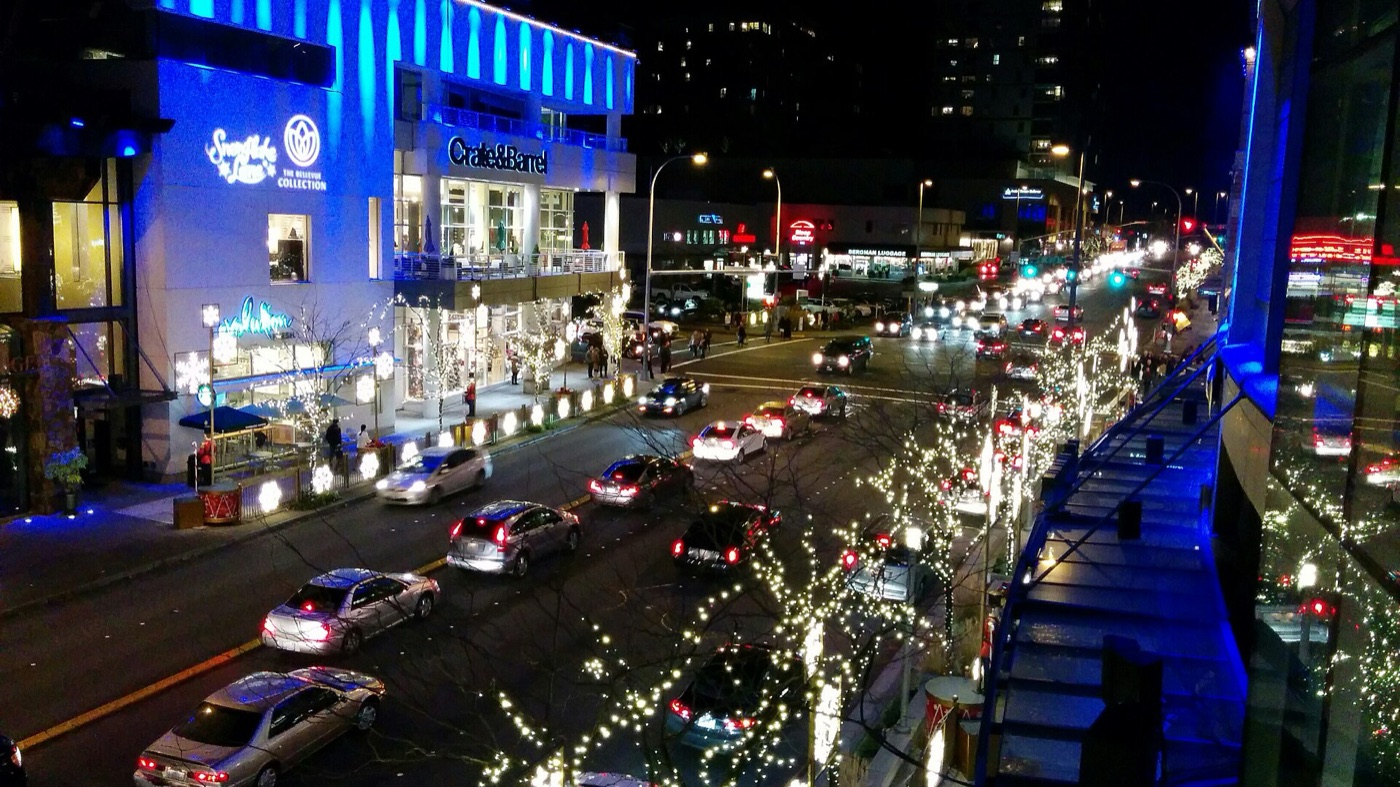
Bellevue Way at Bellevue Square, in the downtown BellHop serves, 2014.
You call it in the app or flag it down, until 9 p.m.
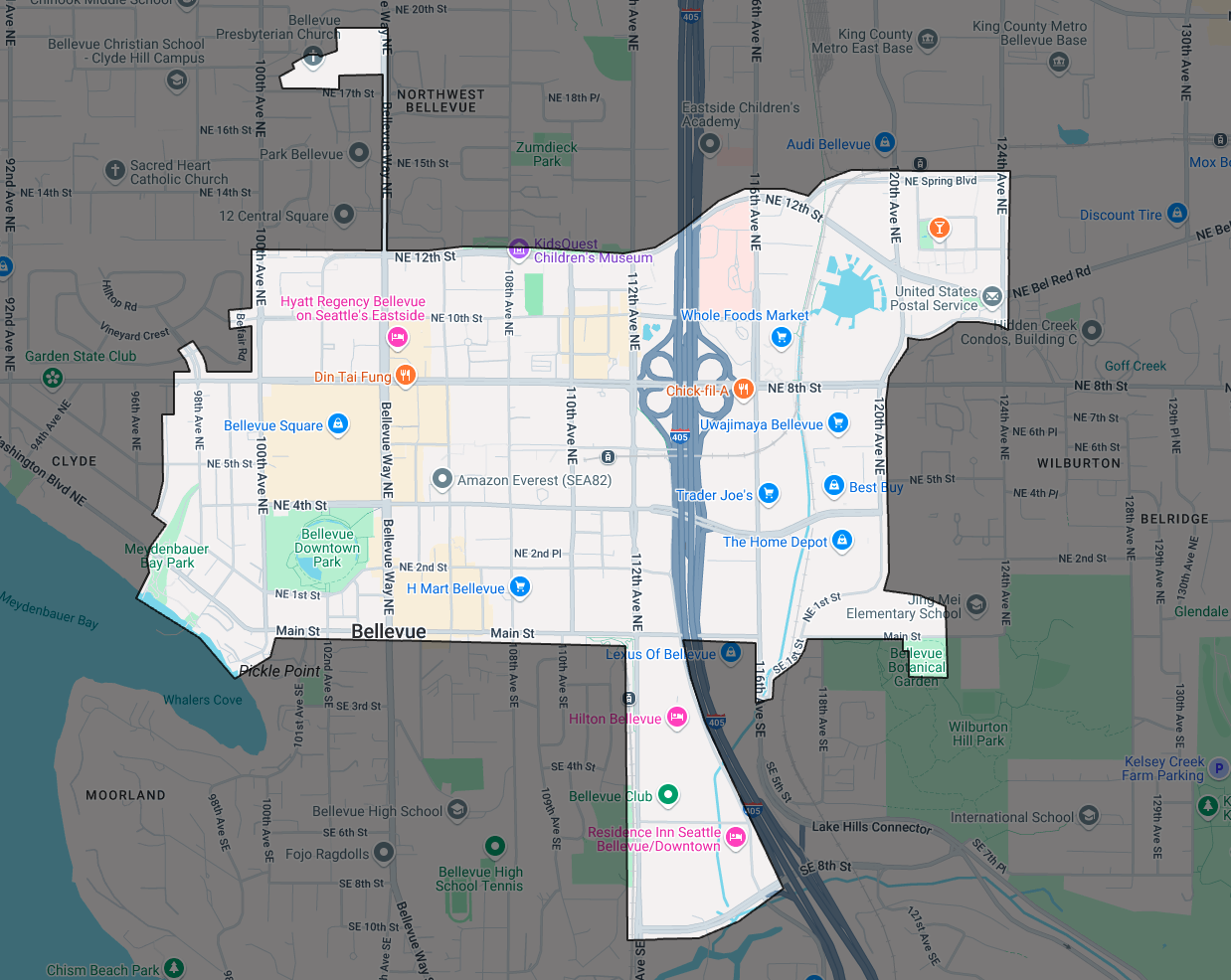
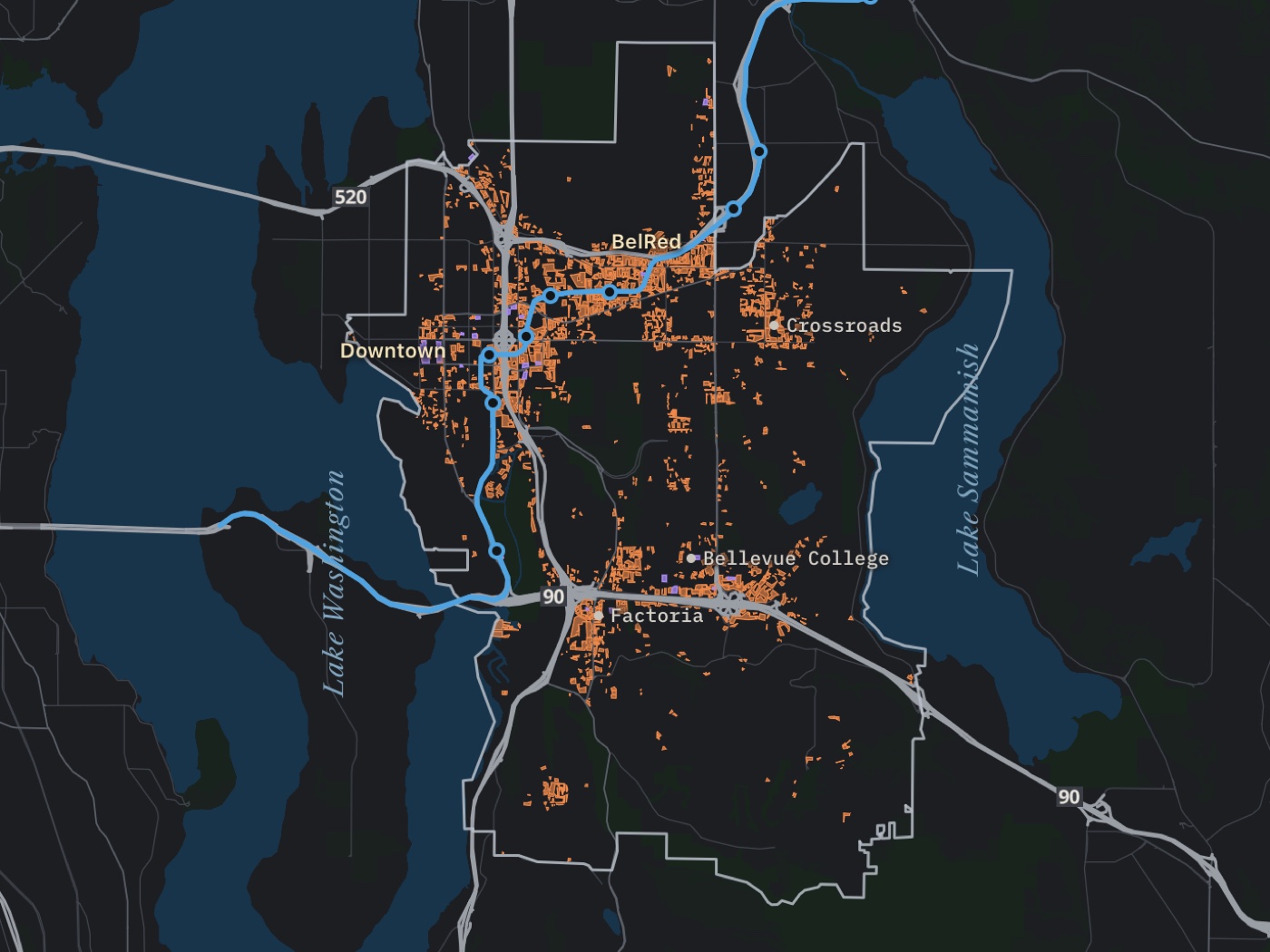
BellHop takes you where you're going rather than along a route, anywhere in downtown and a ring around it: Meydenbauer Bay Park, Meydenbauer Center, the Botanical Garden, the Spring District and the Farmers Market are all inside. Visit Bellevue, which runs the service, calls the area a "6-mile perimeter". The app tells you whether a particular trip is in it.
Two ways to get a ride. Request one in the Circuit app↗, or flag down an empty car. App requests come first, and you can't book ahead.
Waits of up to ten minutes, Visit Bellevue says.
Five electric Kia EV9 SUVs since May 2026, replacing the small low-speed carts BellHop started with.
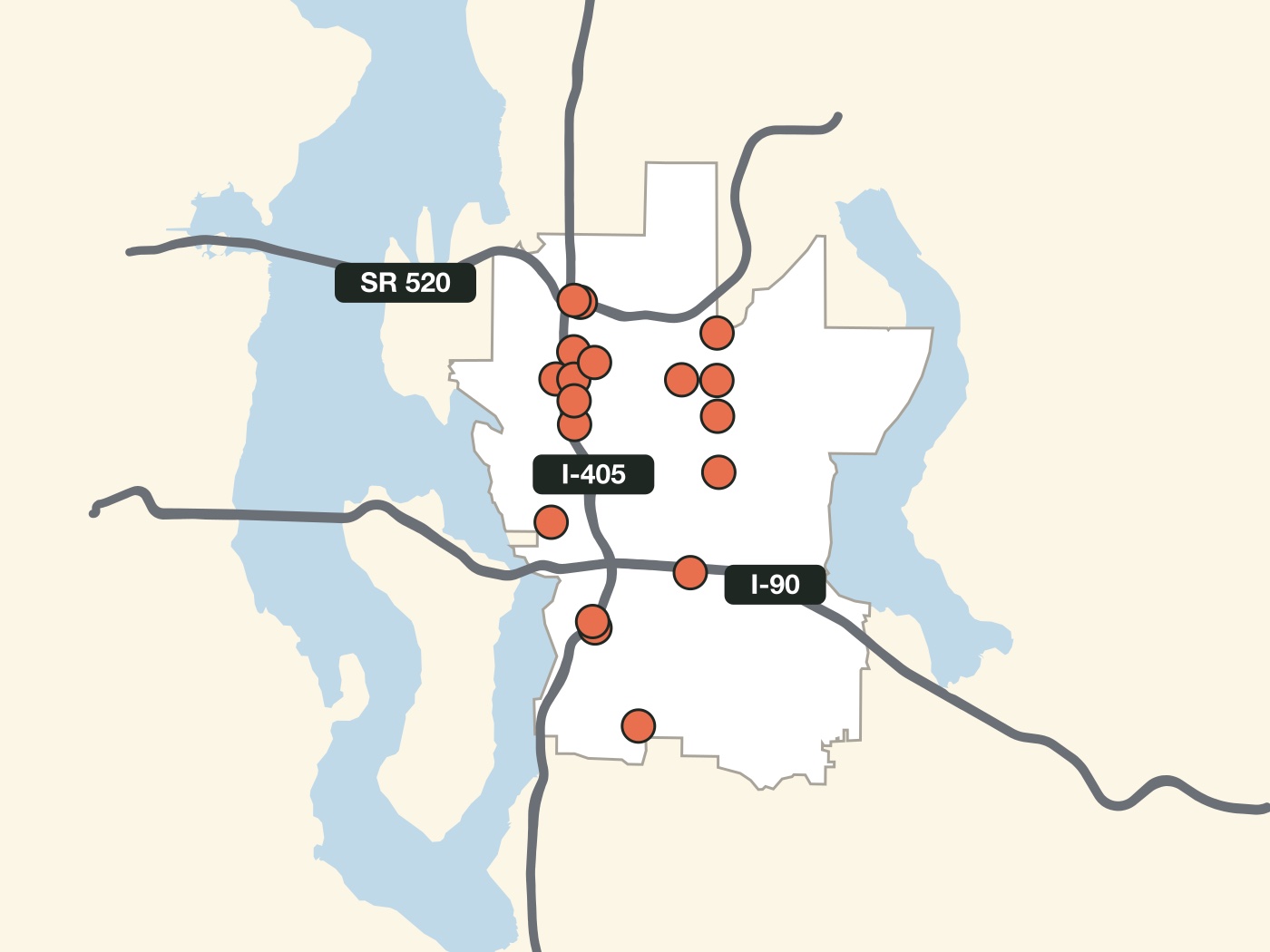
Grocery stores are half its ten busiest stops
BellHop started as a pilot in August 2023 and became a permanent service in June 2024. Visit Bellevue promotes it for hotels, parks and events, but the city's own account of how it's used puts grocery stores at half of its ten most popular destinations: it's an errand service as much as a visitor one.
Visit Bellevue counts trips two ways. A ride is one trip by one car; a passenger is each person on it, so a family of four is one ride and four passengers.
Reported
Rides since launch
Passengers since launch
June 2024
47,200
67,827
May 2026
185,602
248,514
Between those two reports BellHop gave about 138,000 rides, roughly 6,000 a month.
Hotel guests, Amazon and the city pay for it
Visit Bellevue, part of the Bellevue Convention Center Authority, manages BellHop, and a company called Circuit runs the cars. Visit Bellevue put BellHop's 2026 budget at $875,000, 425 Business reported in July↗. The money comes from three places:
Hotel guests. The Tourism Promotion Area is a $2.50 charge on each night's stay that every hotel, motel or other lodging with 40 or more rooms in Bellevue and Redmond collects from its guestsPDF ↗. Bellevue's code↗ keeps each city's share for tourism in that city, so BellHop's part comes from stays at all of Bellevue's hotels, not only those it stops at. BellHop is one line in what that money pays for.
Amazon, a funding partner since June 2024, with no amount published.
The City of Bellevue,$150,000 a year in 2025 and 2026.
Puget Sound Energy's electrification grant helped pay for the electric fleet and its chargers.
The city pays about a sixth of BellHop's budget
BellHop's 2026 budget, $875,000 as Visit Bellevue gave it to 425 Business, against the city's $150,000 for 2026 in its adopted budget. The rest comes from the hotel charge and Amazon; Visit Bellevue hasn't published how it splits. The source doesn't say whether the $875,000 includes the light rail shuttle.
Most of the money goes to Circuit, which runs the cars
The city's $150,000 goes to Visit Bellevue, not to the operator, and Visit Bellevue pays Circuit. What Circuit's bill covers isn't published, but its size is:
The hotel charge paid Circuit $36,255 in May 2026 and $67,510 in June,the Tourism Promotion Area's July ledgerPDF ↗ shows. June's payment alone is close to a twelfth of BellHop's $875,000 year, so most of the budget looks like the operator's bill.
Circuit hires and pays the drivers, whom it calls Driver Ambassadors, and its standard offer bundles the drivers, the cars, insurance, the app and ride reports in one price.
The split inside that price isn't public. Visit Bellevue's 2024 request for an operator weighted price at 40% of the score but set no format for it: no hourly rate, no monthly fee, and nothing on who pays for charging or repairs. The contract would show it, and Visit Bellevue, a public authority, is subject to records requests.
The proposed budget keeps the city's share at $150,000 a year
The city's own money started in mid-2024. Visit Bellevue paid for the pilot alone until the end of May 2024; Amazon and the city then put up $585,000 between them for the rest of that year, a split that wasn't published. The 2025–26 adopted budgetPDF ↗ gave BellHop $150,000 a year from Community Development.
The preliminary 2027–28 budget↗ carries the same $150,000 a year, $300,000 over two years from the General Fund, and moves the line to the Transportation department. It's the same number of dollars, so a little less in real terms.
BellHop is 3 cents of every $100 in the city's General Fund
Each square is one ten-thousandth of the city's proposed General Fund for 2027 and 2028, $964.2 million in all. BellHop's $300,000 is 3.1 squares, or 3 cents of every $100. Proposed, not adopted. Source: City of Bellevue, preliminary 2027–28 budget (transmittal letter and Transportation's proposals).
Among the Transportation department's new and expanded items for the two years, BellHop's $300,000 sits beside $3.1 million for parking and curb management and $2.2 million for speed safety cameras.
For its 3 November deliberation, staff gave the Council four ways to pay for transportation over ten years. Two of them, a new hybrid called Scenario 2B and Scenario 3, each add $300,000 for "BellHop Interim Support" to the capital plan; the preliminary budget and Scenario 2 leave it unfunded (scenario comparisonPDF ↗). Both depend on a 0.1% sales tax through the city's Transportation Benefit District, and Scenario 3 adds a $20 vehicle registration fee (staff memoDOCX ↗). If the Council gives no direction, the preliminary budget's plan goes ahead. It is due to give its budget direction on 10 November and to adopt the budget on 17 November. This page will update with what it adopts.
Next: the rail shuttle ends, and parking may pay for evenings
A light rail shuttle ends in December. Since this summer, two Volkswagen ID. Buzz vans have run from Bellevue Downtown Station on weekdays, 8 a.m. to 6 p.m., with no app needed. Amazon pays the pilot's $150,000. Visit Bellevue wants to keep it, and the hotel board's June minutes say the pilot will shape more cars and partners in 2027.
Parking meters could pay for later hours. The city's plan to start charging for street parking downtown includes using the money for late-night BellHop service, The Urbanist reported↗. Paid parking is planned for spring 2027, and the revenue has to cover its setup costs first.
How this was checked
Checks against this finding
Sources read 28 October 2026. Hours, destinations and the fleet come from Visit Bellevue's service page and its 14 May 2026 fleet announcement. Where the two disagree (the service page still describes six low-speed cars), the dated announcement is used. The city's budget figure comes from the preliminary budget and the Council's October budget materials.
Ridership is self-reported. Every ride and passenger count comes from Visit Bellevue or Circuit, and none is independently audited. Other reports disagree: two spring 2025 accounts differ by about 19,000 rides within a week, and Circuit's case study mixes rides with passengers. The table uses the two Visit Bellevue announcements that report both measures separately. A later announcement's "250,000 passenger rides" blurs the two. Neither measure counts unique people, and none says how many riders live, work or stay in Bellevue. The monthly rate is the difference between two cumulative totals, so it averages over a period when the fleet and hours changed.
No cost per ride. The $875,000 is a 2026 budget, and the source doesn't say whether it includes the rail shuttle; there's no ride count for the same year to divide it by. The $150,000 city line is one funder's share for 2027 and 2028, not the cost of the service. Visit Bellevue's economic-impact and fuel-saving claims are left out because their methods aren't published.
The budget shares are simple division. "A sixth" is the city's $150,000 for 2026 against Visit Bellevue's $875,000 for 2026. The grid splits the General Fund alone, $964.2 million for the two years, into 10,000 squares of about $96,000 each, because that is the fund the line draws on; BellHop's $300,000 fills three. Against all city funds, $2.3 billion, it is about 1 cent of every $100.
What the budget lines don't settle. Both budgets list BellHop as an "Adjustment to Base", which the 2025–26 book defines as an existing program changed beyond inflation. Asked by a councilmember which programs run on one-time money or reserves, the city listed BellHop's $300,000 among them (Council memory bank, attachment CPDF ↗), so it is re-funded each budget rather than carried forward. That page's heading reads "Scaled or Not Funded"; its section and the question it answers say one-time funded. The 2025–26 figures are budgeted amounts, not payments; a $300,000 city award to Visit Bellevue dated March 2025 in a contracts database matches them. No city figure for 2023 or 2024 was found; the 2023–24 budget has no BellHop spending line. The capital plan's "BellHop Interim Support" line is separate from that operating line, and the 3 November packet doesn't say how the two relate or what "interim" covers. Money in the budget doesn't confirm a 2027 operating contract: Visit Bellevue's last operator request covered 2025 with an option for 2026.
Waits and service area vary by source. Circuit's own figures range from six minutes in a blog post to a 10.8-minute average in its statistics, against Visit Bellevue's "up to ten". Visit Bellevue publishes the service area as a picture, not a boundary file, so the map here is our tracing of that picture, tied to street intersections from OpenStreetMap; its edges are good to about 15 metres. Factoria and Crossroads were optional areas in the operator request, with no sign service reached either.
The operator payments are one funder's. The two Circuit payments are what the hotel charge paid, not Circuit's whole bill: Amazon's and the city's money reaches Visit Bellevue separately and may be paid on in lumps. The payments vary month to month, and the ledger doesn't say what they were for. Earlier months' ledgers weren't in the board packets we could read. Circuit's description of what its price bundles comes from a 2021 sales presentation to another county, not from the Bellevue contract.
Bellevue City Code, chapter 4.60↗: each city's charges spent on tourism in that city. The code site refused our fetch; read from its search excerpt, 31 October 2026.
Bellevue Way at Bellevue Square, in the downtown BellHop serves, 2014: Dawid Glawdzin, 2014, CC BY 3.0, via Wikimedia Commons.
Updates and corrections.
Updated 4 Nov 2026. On 3 November staff gave the Council a new transportation option, Scenario 2B, which like Scenario 3 adds $300,000 for BellHop Interim Support to the capital plan; the city also listed BellHop's $300,000 among programs paid with one-time money.
New stories from Bellevue, in your inbox
One email when a new story is published, with any corrections. Nothing else.